
How does an off-grid solar system work at night?
The core value of solar power off the grid systems lies in their ability to provide power when the sun is down. Understanding this nightly operation is essential insight for making a confident investment.
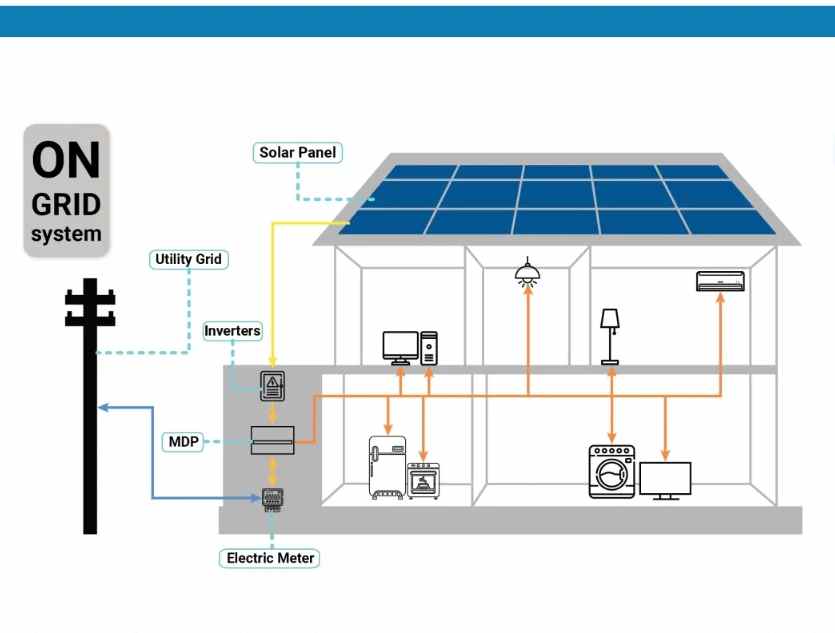
Intelligent Energy Management: A Complete Closed Loop from Generation to Storage
The core of an off-grid solar system lies in establishing an independent generation-storage-supply energy cycle. During the day, photovoltaic modules convert solar energy into electricity, which is intelligently distributed through a solar charge controller: prioritizing real-time load demand, and storing surplus energy in the battery bank with optimal charging parameters.
It is worth noting that the system’s power generation is closely related to solar irradiance, ambient temperature, and the installation angle of the modules. During the system design phase, it is necessary to accurately calculate the local peak sunshine hours to ensure that the photovoltaic array’s power generation capacity is sufficient to cover daytime loads and achieve energy storage targets.
Energy Storage System: The Core Guarantee for Nighttime Power Supply
The battery bank acts as an “energy bank” within the system. Currently, the mainstream energy storage solution is lithium iron phosphate (LFP) batteries. Compared to traditional lead-acid batteries, they outperform traditional lead-acid batteries in terms of cycle life (generally exceeding 3000 cycles), safety, and energy density, making them particularly suitable for industrial and commercial applications with high reliability requirements.
When evaluating battery performance, focus on usable capacity rather than nominal capacity. Considering the impact of depth of discharge on battery life, professional system designs typically retain 20%-30% redundant capacity to avoid performance degradation due to over-discharge.
Power Conversion: The Key Role of the Inverter
During nighttime power supply, the inverter is responsible for converting the DC power from the battery into the AC power required by the equipment. For industrial and commercial applications, pure sine wave inverters should be selected to ensure compatibility with motor-type equipment (such as water pumps and compressors) and precision instruments.
Energy efficiency is particularly important: a high-quality inverter should have a conversion efficiency exceeding 95% and standby power consumption below 1%. Some high-end models also feature intelligent power distribution capabilities, automatically adjusting output strategies based on load priority.
System Design and Capacity Planning
Professional off-grid system design must be based on a detailed energy audit:
- Accurately record the power consumption and average daily operating time of each device.
- Differentiate between critical and non-critical loads.
- Calculate the system’s total daily energy consumption (kWh).
Battery capacity planning needs to consider “self-sufficiency days”—the number of days the system can operate independently without solar input. For industrial and commercial applications, a 3-5 day safety margin is recommended to cope with consecutive rainy days.
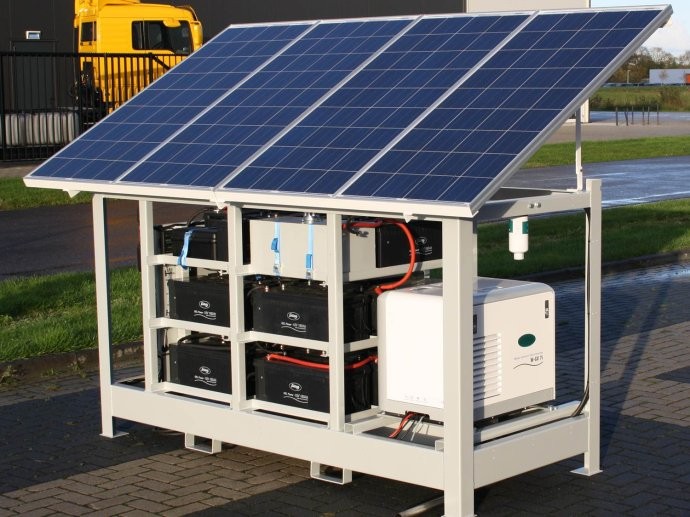
Backup Energy: Ensuring System Reliability
Under extreme weather conditions, integrating a backup generator is a reliable solution to ensure uninterrupted power supply. Modern off-grid systems can be configured with an automatic start switch that automatically starts the generator when the battery level drops to a preset threshold, achieving fully unattended operation.
This hybrid energy solution ensures power supply reliability while avoiding the cost pressure of excessive battery capacity, making it an effective strategy for achieving optimal return on investment.
Professional Advice
Building a reliable off-grid power system requires systematic and professional considerations:
- Select a lithium iron phosphate battery system with a long cycle life.
- Ensure a perfect match between the inverter and load characteristics.
- Conduct capacity planning based on a detailed energy audit.
- Configure automatic backup power generation systems in critical applications.
Through scientific system design and equipment selection, off-grid solar systems can provide stable power comparable to the grid for various industrial and commercial applications, while significantly reducing long-term operating costs, achieving a win-win situation of energy independence and sustainable development.