
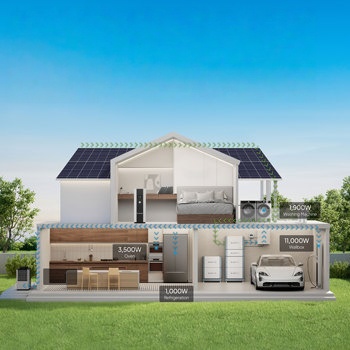
How big of a solar battery banks do I need to power a house?
The Risk of Underestimating Your Energy Needs
Imagine the local power grid fails during a seasonal storm, yet your home remains a sanctuary of light and comfort. Your appliances continue to run, your communication devices stay charged, and your food remains preserved. This level of security is the primary reason why homeowners worldwide are investing in solar battery banks.
However, the success of such a system depends entirely on one factor: accurate sizing. Estimating your storage needs is not a matter of guesswork; it is a technical calculation that balances your consumption habits against the physical limits of battery chemistry.
If you undersize the system, you face frequent blackouts during cloudy spells. If you oversize it, you overspend on capacity that may degrade before it is ever fully utilized. This guide provides a professional, globally applicable framework to help you determine the exact storage volume required for your household.

Why is a Detailed Energy Audit the First Step?
Before evaluating hardware, you must quantify your “energy footprint.” Most people are accustomed to looking at a monthly utility bill, but for off-grid or backup design, we must speak the language of Watt-hours (Wh) or Kilowatt-hours (kWh) per day. This is the bedrock of your entire system design.
Start by conducting a thorough energy audit. Every device—from the high-draw washing machine to the low-draw Wi-Fi router—must be listed. The fundamental formula for calculating the daily consumption of a single device is:
Daily Consumption (Wh) = Power Rating (W) × Daily Use (h)
According to the International Renewable Energy Agency (IRENA), while energy use varies by region, an energy-conscious household typically consumes between 8 kWh and 15 kWh per day. To find your total daily load, you must sum the consumption of all devices:
Total Daily Load (Wh) = ∑(Power × Time)
You must also account for “Phantom Loads”—the small, constant drains from appliances in standby mode. In a standard home, these can silently consume up to 1 kWh per day. Without this precise daily total, you cannot accurately select solar battery banks.
How Many Days of Autonomy Should You Plan For?
Solar energy is inherently intermittent. To ensure a reliable supply, you must decide on your “Days of Autonomy.” This term refers to the length of time your battery bank can power your house without any input from your solar panels—essentially, how long you can survive a period of heavy rain or thick cloud cover.
In many parts of the world, weather patterns can be unpredictable. Professional installers generally recommend a minimum of 2 to 3 days of autonomy for a primary residence. The formula to calculate your required usable energy is:
Required Usable Energy (Wh) = Total Daily Load (Wh) × Days of Autonomy
Choosing your autonomy level is a strategic decision. If you live in a region with high solar irradiance year-round, you might lean toward a 1.5-day buffer to save on initial costs. In monsoon-prone or high-latitude regions, 3 days is the safety standard. This buffer ensures that your solar battery banks aren’t stressed to their limits every time the sun disappears for a day.
How Does Battery Chemistry Affect the Final Size?
One of the most common misconceptions in the industry is that a battery’s “labeled capacity” is the amount of energy you can actually use. In reality, the chemistry of the battery—whether it is traditional Lead-Acid or modern Lithium Iron Phosphate (LiFePO4)—changes the math entirely due to the Depth of Discharge (DoD).
Lead-acid batteries (including AGM and Gel types) are physically restricted. To prevent permanent chemical damage, they should rarely be discharged beyond 50% of their total capacity. Lithium batteries, however, are far more robust. High-quality LiFePO4 solar battery banks can safely be discharged to 80% or 90% of their rated capacity night after night.
To calculate the Nominal Capacity you need to purchase, you must adjust for the DoD:
Nominal Capacity (Wh) = Required Usable Energy (Wh) /Depth of Discharge (DoD)
Consider the practical implications: if your audit shows you need 10 kWh of usable energy, you would need to buy a 20 kWh Lead-Acid bank (at 50% DoD), but only an 11.2 kWh Lithium bank (at 90% DoD). While the lithium units may have a higher price tag per kWh, their superior DoD means you buy less total capacity to achieve the same result.
Why is 48V the Industry Standard for Residential Systems?
When browsing for storage solutions, you will encounter 12V, 24V, and 48V configurations. While 12V is standard for small portable kits or vehicles, it is inefficient for powering an entire house. As your power requirements grow, the current (Amperes) required at low voltages becomes difficult to manage.
For a residential system, 48V has become the global industry standard. The reason is rooted in Ohm’s Law and the calculation of power:
Power (W) = Voltage (V) × Current (A)
By quadrupling the voltage from 12V to 48V, you reduce the current by 75% for the same amount of power. Lower current means less heat generation and significantly less “voltage drop” over your cables. Using 48V allows you to use thinner, more cost-effective wiring while maintaining higher overall system efficiency.
Most premium solar battery banks and professional-grade off-grid inverters are designed natively for 48V. This architecture also makes it far easier to expand your system in the future by adding modular battery units in parallel.
Are You Accounting for the ‘Efficiency Tax’?
No electrical system is 100% efficient. When energy moves from your batteries through an inverter to become the AC power your appliances use, some of that energy is lost as heat. This is often referred to as the “conversion loss” or the “Inverter Tax.”
Most modern, high-quality off-grid inverters have an efficiency rating between 90% and 95%. Additionally, you must consider the “Round-trip Efficiency” of the battery itself. Lithium batteries are remarkably efficient (around 95-98%), whereas lead-acid batteries lose significant energy during the charge/discharge cycle (often only 80-85% efficient).
The final formula to determine the total Amp-hour (Ah) capacity you need to purchase at your chosen system voltage is:
Required Ah = Required Usable Energy (Wh) / System Voltage (V) × DoD × Inverter Efficiency
A standard professional practice is to include an additional 15% to 20% safety margin. This buffer covers inverter losses, cable resistance, and the minor “self-discharge” that all batteries experience over time.
Can Your System Handle Sudden Surge Loads?
Sizing isn’t just about total energy (kWh); it’s also about power delivery (Amps). Many household appliances, such as well pumps, refrigerators, and power tools, require a massive “surge” of current to start their motors. This surge can be three to five times higher than their normal running wattage.
Your battery bank must have the “muscle” to provide this instantaneous current without a significant voltage drop. If the voltage sags too low during a surge, the inverter may trigger a safety shutdown, plunging the house into darkness even if the batteries are nearly full.
Lithium technology excels here. Lithium solar battery banks generally have a higher “C-rating,” meaning they can be discharged at a much faster rate relative to their size than lead-acid batteries. When you ask, “how big of a battery bank do I need,” you must ensure the bank’s maximum continuous discharge current meets the combined surge requirements of your largest appliances.
How Does Temperature Affect Effective Capacity?
Batteries function as electrochemical devices, so temperature directly affects their performance. You must adjust your sizing calculations if you install your storage system in an uninsulated garage or shed prone to extreme seasonal shifts.
Cold weather presents a significant hurdle. Every 10°C drop below the 25°C threshold causes a lead-acid battery to lose roughly 10% of its effective capacity. While lithium (LiFePO4) batteries sustain their capacity more efficiently in the cold, they require internal heating elements to charge safely once temperatures hit the freezing point (0°C).
If you live in a harsh climate, you must factor in a “Temperature Correction Factor.” This usually involves adding a 15% to 20% margin to your battery bank size to compensate for seasonal capacity loss. Alternatively, ensuring your solar battery banks are housed in a climate-controlled environment allows you to stick closer to your original mathematical requirements.
Building a Foundation for Autonomy
Calculating the size of your battery bank is the most important investment you will make in your home’s energy future. By accurately auditing your daily loads, selecting the right chemistry, and accounting for system efficiencies and environmental factors, you move from guesswork to engineering certainty.
True energy independence is about more than just having solar panels on the roof; it is about having a “reservoir” of energy that is perfectly matched to the rhythm of your life. While the upfront cost of high-quality LiFePO4 solar battery banks and 48V architectures may be higher, the long-term reliability and lower cost-per-cycle make them the most logical choice for a modern home.
If you are ready to stop guessing and start building a resilient power system, contact our technical support team. We specialize in global energy solutions and can help you refine these calculations based on your specific location and lifestyle. Let us help you ensure that your home remains powered, protected, and independent for years to come.