

How does an solar inverter work?
An solar inverter is a converter that converts DC electrical energy into fixed-frequency, fixed-voltage or frequency and voltage regulated AC power. It consists of inverter bridge, control logic and filter circuit. It is widely used in air conditioners, home theaters, electric grinding wheels, power tools, sewing machines, DVDs, VCDs, computers, televisions, washing machines, range hoods, refrigerators, VCRs, massagers, fans, lighting and so on.
1. Working principle of solar inverter
Solar inverter is a kind of DC to AC transformer, which is actually a voltage inversion process with the converter. The converter is to transform the AC voltage of the grid into a stable 12V DC output, while the inverter is to transform the 12V DC voltage output from the Adapter into a high-frequency high-voltage alternating current (AC); the two parts of the same are used more pulse width modulation (PWM) technology. The core part is a PWM integrated controller, the Adapter is UC3842, the inverter is used TL5001 chip. TL5001 operating voltage range of 3.6 ~ 40V, its internal set of an error amplifier, a regulator, oscillator, deadband control of the PWM generator, low-voltage protection circuit and short-circuit protection circuit and so on.
Input interface part: There are three signals in the input part, 12V DC input VIN, work enable voltage ENB and Panel current control signal DIM. VIN is provided by the Adapter, ENB voltage is provided by the MCU on the main board, and its value is 0 or 3V, when ENB=0, the inverter does not work, and ENB=3V, the inverter is in the normal working state; and DIM voltage is provided by the main board, and its value is 0 or 3V, and the inverter is in the normal working state. DIM voltage is provided by the main board, and its variation range is between 0 and 5V. Different DIM values will be fed back to the feedback terminal of PWM controller, and the current provided by the inverter to the load will be different, and the smaller the DIM value is, the larger the current output from the inverter will be.
Voltage start circuit: When ENB is high, it outputs high voltage to light up the backlight tube of Panel.
PWM Controller: It has the following functional components: internal reference voltage, error amplifier, oscillator and PWM, over-voltage protection, under-voltage protection, short-circuit protection, and output transistor.
DC converter: the voltage converter circuit is composed of MOS switching tube and energy storage inductor, the input pulse is amplified by push-pull amplifier to drive the MOS tube to do the switching action, which makes the DC voltage charge and discharge the inductor, so that the other end of the inductor can get the AC voltage.
LC oscillation and output circuit: ensure the 1600V voltage needed for the lamp to start, and reduce the voltage to 800V after the lamp starts.
Output voltage feedback: when the load is working, the feedback sampling voltage plays the role of stabilizing the voltage output of I inverter.
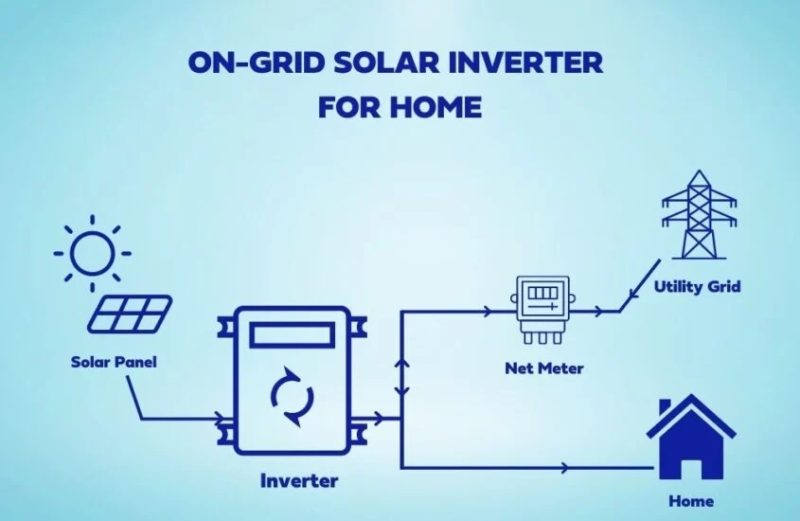
2.the role of the solar inverter
Inverter is the DC power (battery, storage battery) into AC power (generally 220v50HZ sine or square wave). In layman’s terms, the inverter is a direct current (DC) into alternating current (AC) device. It consists of an inverter bridge, control logic and filtering circuit.
Simply put, an inverter is an electronic device that converts low-voltage (12 or 24 or 48 volts) DC to 220 volts AC. The inverter is so named because it usually rectifies 220 volts AC to DC for use, while the inverter does the opposite. In a “mobile” era, mobile office, mobile communication, mobile leisure and entertainment. In this mobile state, not only do we need low voltage DC power supplied by batteries or electric batteries, but we also need 220V AC power which is indispensable in our daily environment, and inverters can fulfill the needs.
We have more styles of inverter, contact us to learn more!