
how long does it take to charge a lithium battery?
The Reality of Charging Speed
Are you staring at a flickering LED on your charger and wondering: how long to charge a lithium battery? It is the most common question among new owners of LiFePO4 and Lithium-ion systems. Unlike older lead-acid technology, lithium batteries accept energy with remarkable efficiency, but they still follow the strict laws of physics.
Understanding your charging window is not just about patience; it is about system health. If you charge too slowly, you may not be ready for your next off-grid adventure. If you force too much current too fast, you risk triggering the Battery Management System (BMS) or reducing the cell’s lifespan. This guide will provide the exact formulas and variables you need to calculate your downtime with precision.
The Core Formula: Calculating Your Wait Time
At its most basic level, charging time is a relationship between the capacity of the battery and the strength of the charger. We measure battery capacity in Amp-hours (Ah) and charger strength in Amperes (A).
The fundamental equation to estimate how long to charge a lithium battery is:
Time (Hours) = Battery Capacity (Ah) / Charger Current (A)
For example, if you have a 100Ah battery and a 20A charger, the math suggests a 5-hour window. However, real-world conditions are rarely 100% efficient. To get a more realistic estimate, professionals usually add a 10% buffer to account for the “tapering” phase at the end of the cycle and minor energy loss as heat.
Realistic Time ≈ Ah / A ×1.1
Why Does the Charging Stage Change the Speed?
Lithium batteries do not charge at the same speed from 0% to 100%. They follow a two-stage process known as CC/CV (Constant Current / Constant Voltage). Understanding this helps you realize why the last 5% often feels like it takes the longest.
1. Constant Current (CC) Phase:
During this initial stage, the charger pushes its maximum rated amperage into the battery. If you have a 50A charger, it delivers 50A steadily. This is the fastest part of the process, typically taking the battery from 0% to about 90-95% of its capacity.
2. Constant Voltage (CV) Phase:
Once the battery reaches its upper voltage limit (typically to for a 12V LiFePO4 battery), the charger maintains that voltage but begins to drop the current. The Amps slowly trickle down as the cells “soak” up the final bits of energy. This is why the final stage of how long to charge a lithium battery can be deceptively slow.
Does the First Charge Take Longer?
Many manufacturers, emphasize the importance of the “initial charge.” When you receive a new lithium battery, it usually ships at a 30% to 50% State of Charge (SOC) due to international shipping safety regulations.
You should always charge a new battery to 100% before its first use. This is not because the battery is “weak,” but because the internal BMS needs to calibrate. The first charge allows the BMS to “balance” the individual cells. If the cells are significantly out of alignment, the BMS may slow the charging current to a crawl to ensure every cell reaches the target voltage safely. Plan for a few extra hours during this first session.
How Voltage Affects the Charging Math?
A common point of confusion arises when comparing 12V, 24V, and 48V systems. While the Amp-hour (Ah) rating might be the same, the total energy (Watt-hours) is vastly different.
A 48V 100Ah battery holds four times the energy of a 12V 100Ah battery. Therefore, if you use a charger with the same “Wattage” (power output), the 48V battery will take four times longer to charge. When calculating how long to charge a lithium battery, always ensure your charger’s voltage matches your battery bank. Using a 12V charger on a 48V battery will result in zero charge, while using a 48V charger on a 12V battery will likely cause an immediate, permanent failure of the BMS.
The Impact of Charger Amperage on Battery Health
It is tempting to buy the largest charger available to minimize your wait. However, every lithium battery has a “Maximum Continuous Charge Current.” Most LiFePO4 batteries are designed for a 0.5C charge rate.
- 0.5C Rate: For a 100Ah battery, this is 50A. This is the “safe zone” that balances speed with longevity.
- 1C Rate: This is 100A for a 100Ah battery. While some high-end batteries handle this, it generates more heat and may slightly shorten the cycle life over several years.
If you are consistently asking how long to charge a lithium battery because you are in a rush, upgrading to a 0.5C charger is usually the most efficient and safest upgrade you can make.
Environmental Variables: The Temperature Factor
Lithium batteries are electrochemical devices, and their internal resistance changes with the temperature. Cold weather is the biggest enemy of charging speed.
Most lithium BMS units will significantly throttle or entirely block charging current if the internal temperature drops below 0 ℃ (32°F). Even at slightly higher temperatures (e.g.,5℃ ), the battery may refuse to accept high amperage to prevent “lithium plating.” If you are charging in a cold garage or an uninsulated RV compartment, your charging time will increase significantly as the BMS protects the cells.
Why Efficiency Makes Lithium the Faster Choice?
If you are coming from a lead-acid background, you will notice that lithium is significantly faster, even with a smaller charger. Lead-acid batteries have poor “charge efficiency”—often around 80%. This means you have to put 120Ah of energy into the battery to get 100Ah of usable storage.
Lithium batteries boast an efficiency of 98% to 99%. Almost every Amp that leaves your charger successfully settles into the battery. This high efficiency is a major reason why the answer to how long to charge a lithium battery is almost always “faster than your old one.” You waste less time and less electricity during the process.
Managing the “Last Mile”: The Balancing Act
As a battery nears 100%, the BMS enters a “balancing mode.” It bleeds off energy from cells that are too high and allows lower cells to catch up. If you have a high-quality battery that you use frequently, this process is quick.
However, if your battery has been sitting in a partially discharged state for months, the cells may have “drifted.” In this scenario, the charger might stay in the final CV phase for several hours as the BMS works to align the cell voltages. Do not unplug the battery during this stage; allowing the BMS to finish its balancing work is vital for maintaining the total capacity of your pack.
Safety Check: Can You Overcharge?
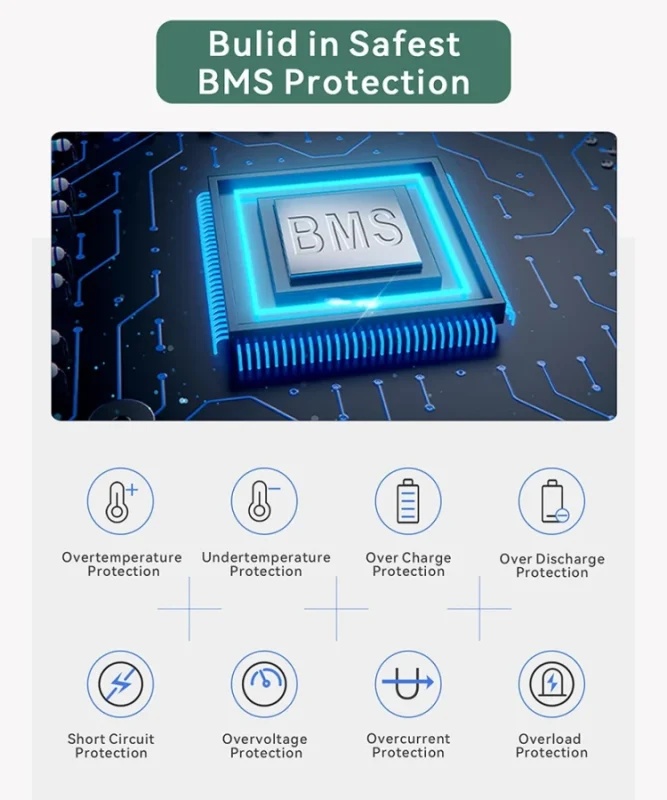
Modern lithium batteries are essentially “set it and forget it” devices because of the BMS. Once the cells reach their target voltage, the BMS will physically disconnect the internal circuit from the charger.
Even if you leave the charger connected, the battery will not “overcharge” in the traditional sense. However, for the best long-term health, we recommend disconnecting the charger once the battery is full, or using a charger with a dedicated “Lithium Profile” that drops to a lower float voltage. This prevents the cells from staying under constant high-voltage stress, which can degrade the electrolyte over many years.
final thoughts: Balancing Speed and Longevity
In summary, determining how long to charge a lithium battery is a simple matter of dividing capacity by current, then adding a small margin for the final balancing phase. A 100Ah battery on a 20A charger will consistently take about 5 to 5.5 hours to go from empty to full.
The beauty of lithium technology lies in its flexibility. Whether you use a slow, 5A maintainer or a rapid, 50A professional charger, the battery will manage the intake safely. By understanding the CC/CV stages and respecting temperature limits, you can ensure that your battery is always ready when you are.