
how low can you drain a lifepo4 battery:A Practical Guide to Safe Discharge Limits
LiFePO4 batteries have become the top choice for applications where safety and longevity matter. But many users ask the same critical question: how low can you drain a LiFePO4 battery without causing damage? Understanding this limit is key to maximizing your battery’s lifespan and performance.
Let’s break down the discharge characteristics, safe voltage thresholds, and best practices to help you get the most from your battery.
Understanding LiFePO4 Discharge Behavior
Unlike other battery types, LiFePO4 batteries offer a remarkably flat discharge curve. This means they maintain a nearly constant voltage for about 90% of their capacity, providing stable power until the very end of the discharge cycle. However, once they pass that 90% mark, the voltage drops sharply.
Nominal Voltage: ~3.2V per cell
Fully Charged: ~3.6V per cell
Fully Discharged: ~2.5V per cell
The Safe Discharge Limit: How Low is Too Low?
So, how low can you drain a LiFePO4 battery in practice? The general consensus among experts is that discharging to 2.5 volts per cell is the safe minimum.
The Danger Zone: Draining a cell below 2.5V is considered a deep discharge. This can cause voltage depression, reducing the battery’s capacity and its ability to hold a charge in the future.
Point of No Return: If a cell’s voltage drops below 2.0V, the damage is often irreversible. Attempting to recharge a battery in this state is not only futile but can also be a safety hazard.
Key Takeaway: While you can drain a LiFePO4 battery to 2.5V per cell, for optimal longevity, it’s better to set a higher cut-off voltage (e.g., 2.8V-3.0V per cell) in your system settings.
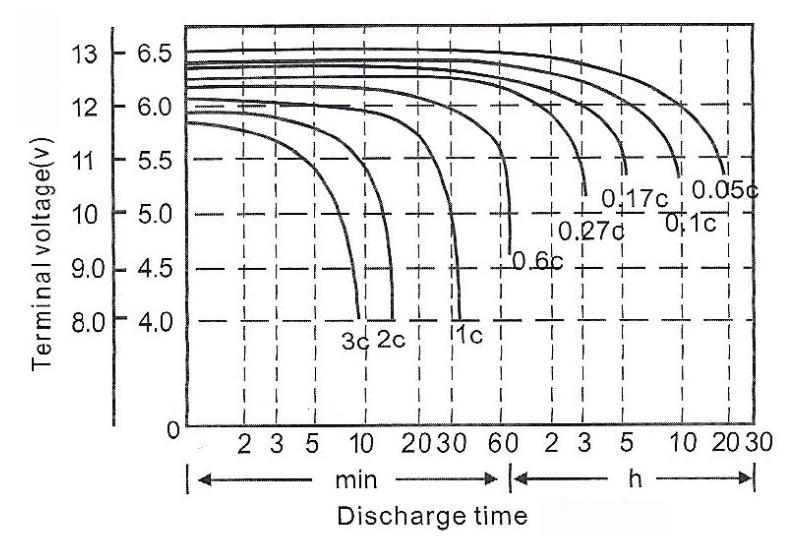
This graph shows the discharge curves of a lithium iron phosphate battery (LiFePO₄) at different discharge rates, illustrating how the terminal voltage changes over discharge time at various discharge rates (C-rates). Below is a detailed explanation:
High-rate discharge (3C, 2C, 1C): High discharge current, short duration (minutes to tens of minutes). Terminal voltage drops rapidly, resulting in steep discharge curves. Voltage decline is more pronounced due to internal resistance, reducing usable capacity (less actual energy delivered).
Medium-to-Low Rate Discharge (0.6C, 0.27C, 0.17C, 0.1C, 0.05C): Lower discharge currents over extended periods (hours to tens of hours).Voltage remains relatively stable until it drops rapidly near the cut-off voltage. The discharge plateau (approximately 3.2V per cell) is distinct and stable, highlighting one of LiFePO₄’s key advantages.
Overall Trend: As the discharge rate decreases, the discharge duration significantly increases. The battery’s energy output approaches its theoretical capacity more closely. The voltage curve declines nearly parallel across different rates, demonstrating LiFePO4′ s excellent rate capability.
Best Practices to Avoid Damaging Deep Discharge
You don’t need to constantly worry about your battery’s voltage. By following these simple steps, you can automate protection and ensure a long service life.
Invest in a Quality BMS (Battery Management System)
This is your first and most important line of defense. A good BMS will automatically disconnect the load when the battery reaches the minimum safe voltage, preventing any risk of over-discharge.
Monitor Voltage During High Demand
During periods of high power consumption, it’s wise to periodically check your battery’s voltage. This is especially crucial for applications like RVs, boats, or off-grid solar systems, where a sudden low-voltage situation can leave you without power.
Adopt Conservative Charging Habits
Think of your battery’s charge cycle like a marathon, not a sprint. Consistently keeping it between 20% and 90% state of charge, rather than always charging to 100% and draining to 0%, will significantly extend its usable life.
fianl thoughts
To directly answer the question, how low can you drain a LiFePO4 battery? — the safe limit is 2.5V per cell. However, the secret to maximizing the value of your LiFePO4 battery isn’t pushing it to its absolute limit; it’s using a quality BMS and adopting conservative usage habits to stay well within the safety margins. This approach ensures you get the thousands of cycles and years of reliable service you paid for.
Contact our energy experts immediately to receive a customized system configuration tailored to your specific energy requirements. We will assist you in selecting the ideal battery pack equipped with a high-quality battery management system and provide methods to maintain efficient battery operation and long-term maintenance.