
What Can a 3000 Watt Inverter Run ?
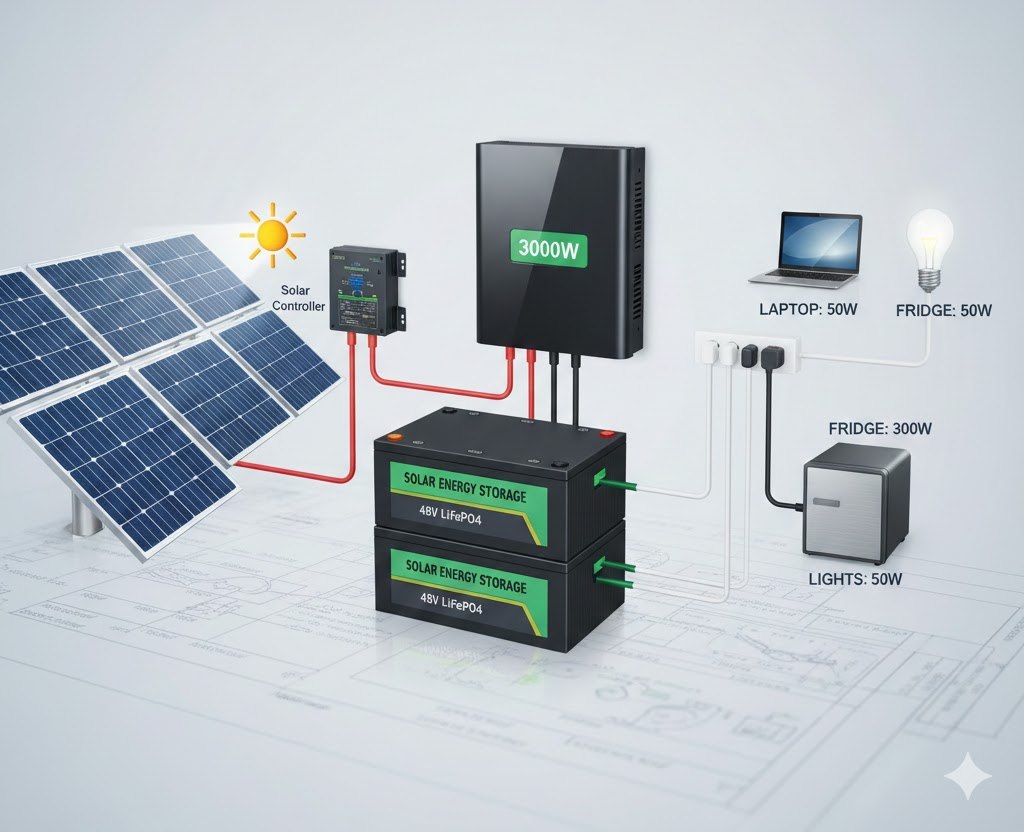
Introduction: Understanding the Value of a 3000W Inverter
If you are planning an off-grid solar setup, an RV power system, or a robust home backup solution, power independence is your goal. The heart of any reliable off-grid system is the inverter. Specifically, the 3000-watt power inverter stands out as the ultimate balance of power, efficiency, and cost.
A 3000W inverter is essentially a power converter. It transforms the Direct Current (DC) electricity stored in your batteries into usable Alternating Current (AC) electricity—the same type of power found in your wall outlets at home.
Choosing the 3000W capacity is a strategic move. It is robust enough to handle high-demand appliances. Yet, it remains manageable for systems across various mobile and stationary applications.
Crucially, you should always opt for a 3000W pure sine wave inverter. Unlike cheaper modified sine wave models, this technology produces clean, grid-like power. This clean output is vital for protecting sensitive electronics like laptops, medical devices, and modern kitchen appliances from potential damage.
The Core Answer: Devices a 3000W Inverter Can Power
So, what can a 3000 watt inverter run? In short, quite a lot!
A high-quality 3000W inverter can provide continuous power for most medium-sized residential and recreational loads. This continuous output is the maximum sustained power it can deliver safely.
However, you must consider the starting or surge power of certain devices. Many appliances, especially those with motors or compressors (like refrigerators), require a brief burst of power, often 2 to 3 times their running wattage, when they first switch on.
A good 3000W inverter guide will detail these power requirements across common scenarios:
| Appliance Category | Device | Running Watts (Approx.) | Surge Watts (Approx.) | Compatible? |
| Kitchen | Microwave Oven (Mid-size) | $800W – 1,200W$ | N/A | YES |
| Full-size Refrigerator | $150W – 300W$ | $1,000W – 1,500W$ | YES | |
| Coffee Maker | $600W – 1,000W$ | N/A | YES | |
| Household | Small Window AC Unit (8,000 BTU) | $700W – 1,200W$ | $1,500W – 2,500W$ | YES |
| Washing Machine | $500W – 1,000W$ | $1,500W – 2,000W$ | YES | |
| LED TV (40 inches) | $50W – 150W$ | N/A | YES | |
| Power Tools | Circular Saw | $1,000W – 1,800W$ | $2,000W – 3,000W$ | YES (If surge limit allows) |
| Electric Drill | $500W – 1,000W$ | $1,000W – 1,500W$ | YES | |
| Medical/Office | CPAP Machine | $30W – 60W$ | N/A | YES |
| Laptop Charger | $50W – 100W$ | N/A | YES |
Detailed Appliance Power Analysis
A 3000W system offers significant flexibility. You can confidently run essential appliances simultaneously.
For instance, you could run a full-size refrigerator (300W), an LED TV (100W), and a few lights (50W). This combined load of 450W is well within the 3000W inverter’s capacity.
The critical factor, as noted, is surge. A good 3000W model often offers a surge capacity of up to 6000W for a few milliseconds. This is essential for handling the momentary startup draw of your refrigerator or water pump without tripping the system.
Critical Considerations for System Performance
To ensure your system runs smoothly and reliably, you must implement a robust load management strategy. Ignoring these factors is the quickest way to experience inverter shutdowns.
Managing Surge Power Demands
Motorized devices require significantly more power to spin up than they need to run continuously. This is the definition of surge power.
You should check the specifications of your appliances. If you have a large air compressor or a heavy-duty power tool, its surge wattage could easily exceed the inverter’s instantaneous limit.
The 3000W unit must be able to handle the highest surge from any single device you start. Our expert recommendation is to leave a significant margin, especially when running inductive loads.
The Load Balancing Rule
Never plan your system based on the maximum capacity of 3000W. Professional system designers follow a conservative approach.
We recommend keeping your continuous total running load below 80% of the rated power. This means your combined appliances should not exceed 2400W (3000W×0.8).
This 20% buffer is crucial. It protects the inverter from overheating, extends its lifespan, and provides a safety net for unexpected surges or fluctuations in power draw. This is an industry best practice for system reliability.
The Importance of High Efficiency
Inverters are not 100% efficient; power is always lost as heat during the conversion process. High-quality pure sine wave inverters operate at 90% efficiency or better.
You need to factor this efficiency loss into your power planning. This loss directly impacts your battery capacity, which is the next, and most crucial, consideration.
Battery System Deep Dive: Calculations and Matching
Answering the question, “what can a 3000 watt inverter run?” is only half the battle. The more important question is: How long can a 3000 watt inverter run these devices?
The 3000 watt inverter runtime is entirely dependent on the capacity of your battery bank. If you use a 3000W inverter but connect it to an undersized battery bank, your power will only last minutes, not hours.
The Battery Capacity Calculation Formula
To avoid guesswork and ensure genuine power independence, you must calculate the required Amp-Hours (Ah) for your batteries. This calculation forms the technical foundation of your system.
Here is the authoritative formula used in the solar storage industry:
Required Battery Capacity (AH) ≈ Load Power(W) × Run Time (h) ÷ [Battery Voltage (V) × Inverter Efficiency (η) × Depth]
- Load Power (W): The total continuous wattage of the devices you plan to run.
- Run Time (h): The number of hours you need the power to last.
- Battery Voltage (V): Typically 12V, 24V, or 48V (48V systems are often more efficient).
- Inverter Efficiency (η): Use 0.90 (90%) for quality inverters.
- Depth of Discharge (DoD): This is critical. For traditional lead-acid batteries, DoD is usually limited to 50%. For modern LiFePO4 (Lithium Iron Phosphate) batteries, DoD can safely reach 0.80 to 0.90 (80%-90%), providing significantly more usable energy.
Practical Example: Determining How Many Batteries for 3000W Inverter
Let’s apply this calculation to a realistic scenario. Suppose you want to use a total continuous load of 1500W (to run a small AC unit, a refrigerator, and lights) for 5 hours overnight.
We will assume a high-performance 48V LiFePO4 battery system and an inverter efficiency of 90% (η = 0.90). The safe DoD for the LiFePO4 battery is 80% (DoD = 0.80).
- Input Data: W = 1500W, h = 5h, V = 48V, η = 0.90, DoD = 0.80
- Calculation:
Required Ah ≈ 1500 × 5 ÷ (48 × 0.90 × 0.80) ≈ 7500 × 34.56 ≈ 217Ah - Result: You need approximately 217 Ah of capacity in a 48V system. If you use standard 100Ah 48V batteries, you would need 217/100 ≈ 2.17 batteries. You would need to round up and purchase three 100Ah batteries to ensure your system meets the 5-hour runtime requirement with a safety margin.
This calculation proves that the most important decision is not just which inverter to buy, but how many batteries for 3000w inverter you need to support the required 3000 watt inverter runtime.
Final: Your Path to Power Independence
The 3000-watt inverter is a powerful, versatile component capable of managing almost all your essential appliances, from a full-sized fridge to power tools and small air conditioners. It’s a workhorse for the off-grid and emergency power market.
The key to unlocking its full potential, however, lies in the quality of its partner: the solar energy storage battery system. High-quality components, like our long-lasting LiFePO4 batteries, maximize your depth of discharge, ensuring you get more usable power and the longevity your investment deserves.
Ready to build a reliable power system that genuinely answers what can a 3000 watt inverter run? Don’t settle for approximate power planning.
Contact our energy experts today to receive a customized system configuration plan based on your exact energy needs. We will help you match the ideal 3000W pure sine wave inverter with the perfect battery bank size.