
what can i run on a 2000 watt inverter?
The Versatility of Portable Power
Choosing the right power source is the first step toward true off-grid freedom. Whether you are outfitting a camper van, preparing for a home emergency, or building a remote cabin, a 2000 watt inverter often represents the “sweet spot” of energy technology. This capacity provides enough muscle to run high-draw kitchen appliances while remaining compact and affordable enough for most mobile setups.
However, you cannot simply plug in every device at once and expect seamless performance. Understanding the limits of your power conversion system ensures you don’t trigger safety shutdowns or damage your sensitive electronics. This guide dives into the technical reality of what you can actually power, how long your energy will last, and the engineering principles that keep your system running smoothly.
What is the Difference Between Continuous and Surge Watts?
Before you list your appliances, you must grasp the two primary ratings of your hardware. A 2000 watt inverter typically provides 2,000 watts of continuous power, but it also features a “peak” or “surge” rating, often reaching 4,000 watts for a few milliseconds.
Continuous power represents the total wattage your inverter can provide for an indefinite period. Surge power exists to handle the “inrush current” required by devices with electric motors, such as refrigerators or power drills. You calculate power using the standard formula:
P(Watts) = V(Volts) × I(Amperes)
If an appliance requires more than your inverter’s surge limit to start, the system will enter a protection mode and shut down. Always check the labels on your devices to ensure their starting wattage stays within your inverter’s peak capacity.
Can You Run Kitchen Appliances on a 2000W System?
The kitchen is usually the most demanding area of any off-grid home. Most modern kitchen gadgets require significant energy to generate heat or turn motors. A 2000 watt inverter handles these tasks well, provided you manage the timing of your loads.
Standard Microwave Ovens:
Most compact microwaves use between 800W and 1,200W of cooking power. However, their actual consumption (input power) is often 20% to 30% higher due to magnetron inefficiency. A 1,200W microwave will pull approximately 1,500W from your battery bank, which fits comfortably within your 2000W limit.
Coffee Makers and Kettles:
A standard drip coffee maker or a single-serve pod machine usually draws between 900W and 1,500W. An electric kettle often pushes closer to 1,500W or 1,800W. While a 2000 watt inverter can run these individually, you must never run a kettle and a microwave simultaneously. Doing so would exceed your continuous limit and blow a fuse or trip the internal breaker.
How Does It Handle Entertainment and Home Office Gear?
If you work from the road or enjoy modern entertainment, you will find that a 2000 watt inverter provides more than enough capacity for these low-to-medium draw devices. In fact, you can often run an entire home office and an entertainment center at the same time.
Laptops and Workstations:
A high-end gaming laptop or a professional video editing workstation pulls between 150W and 300W. A standard MacBook or Chromebook draws less than 60W. You could theoretically run ten laptops simultaneously on a single 2000W unit without breaking a sweat.
Starlink and Networking:
Satellite internet systems like Starlink have become essential for remote living. The Starlink V2 dish pulls about 50W to 75W on average. Combined with a 65-inch LED TV (150W-200W) and a soundbar (50W), your total draw remains under 400W. This leaves plenty of headroom for charging phones, cameras, and drones.
Can You Power a Refrigerator or Air Conditioner?
This is the most common question for RV owners and homeowners seeking backup power. The answer depends heavily on the “Starting Amps” of the appliance.
Refrigerators:
A modern ENERGY STAR-rated refrigerator uses very little power once it is running—often only 100W to 200W. However, the compressor requires a massive burst of energy to start. A 2000 watt inverter with a 4,000W surge capacity can almost always start a standard residential fridge.
Air Conditioning Units:
Small 5,000 BTU window units or efficient 12V/24V rooftop ACs pull around 500W to 800W while running. However, their startup surge can exceed 2,500W. To run these successfully on a 2000 watt inverter, you should install a “Soft Start” capacitor on the AC unit. This device reduces the initial current spike, allowing your inverter to bridge the gap without failing.
Why is Pure Sine Wave Technology Non-Negotiable?
When shopping for hardware, you will encounter “Modified Sine Wave” and “Pure Sine Wave” models. While modified units are cheaper, you should avoid them for a 2000W residential setup.
Pure Sine Wave inverters produce electricity that is identical to (and often cleaner than) the power from your wall outlet. This ensures that sensitive electronics—like CPAP machines, high-end microwaves, and laptops—operate without interference. Modified sine waves can cause motors to run hot, clocks to lose time, and digital screens to flicker. For long-term reliability, always choose a high-quality Pure Sine Wave 2000 watt inverter.
How Do You Calculate Your Battery Requirements?
Your inverter is only as good as the battery bank feeding it. If you draw 2,000 watts from a small battery, the voltage will sag, and the inverter will shut down due to “Low Voltage Disconnect” (LVD).
To find the current draw on your battery, you divide the watts by the system voltage. For a 12V system:
I(Amps) = 2000Watts / 12Volts ≈ 166.7 Amperes
Drawing 166 Amps is a massive load for a single lead-acid battery. This is why we recommend using LiFePO4 (Lithium Iron Phosphate) batteries. Lithium batteries maintain a higher voltage even under heavy discharge, allowing you to utilize the full 2,000W capacity without triggering LVD. A 200Ah Lithium bank is the minimum professional recommendation for a 2000W system.
What are the Critical Safety and Wiring Needs?
Heat is the primary enemy of power electronics. When you pull 2,000 watts, your cables and connections will generate significant heat. You must use the correct wire gauge to prevent fires and energy loss.
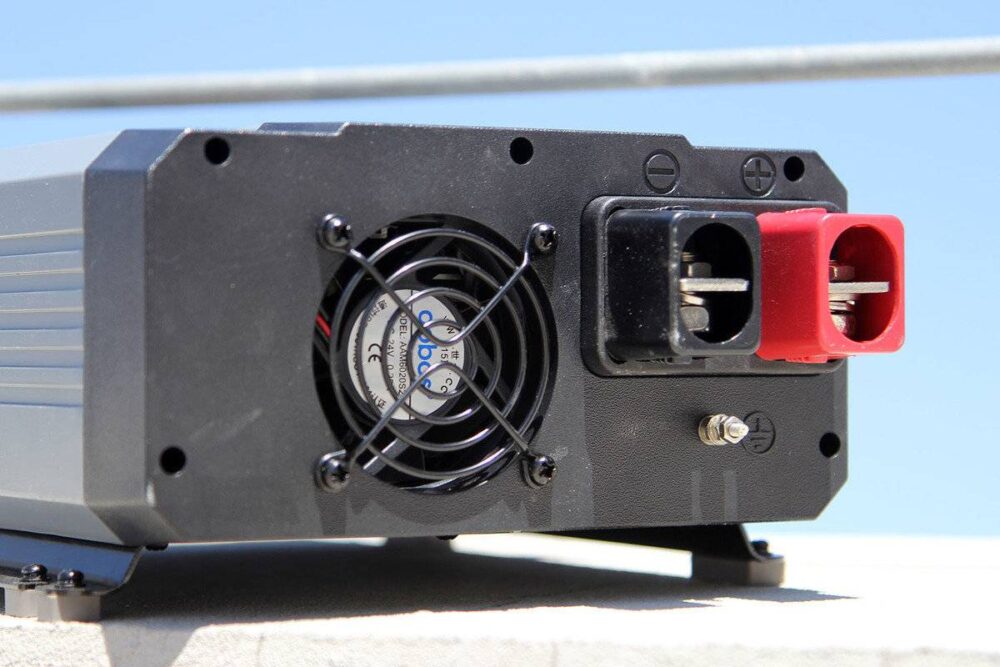
For a 12V 2000 watt inverter, you generally need 00 (2/0) AWG pure copper cables. If your cables are too thin, they act like a bottleneck, creating resistance and causing a voltage drop. This energy loss is calculated as:
P = I² × R
Even a small amount of resistance (R) becomes dangerous when the current (I) is 166 Amps. Additionally, always install a high-quality ANL or Class-T fuse between the battery and the inverter. A 250A fuse is standard for this setup to protect your equipment from short circuits.
What Should You NEVER Run on This Inverter?
While 2000W is powerful, it is not infinite. Managing your expectations prevents frustration and equipment damage. You should avoid running “high-resistance” heating appliances simultaneously.
Avoid trying to power a whole-house electric water heater, a clothes dryer, or an electric oven. These appliances often require 3,000W to 5,000W and usually run on 240V, which a standard 120V 2000 watt inverter cannot provide. Similarly, avoid running a hairdryer (1,875W) and a coffee maker at the same time. One will work; both will fail.
Is a 24V or 48V System Better for 2000W?
If you are building your system from scratch, consider moving to a 24V or 48V battery bank. Higher voltage reduces the amperage required for the same amount of power.
At 24V, the current for 2,000W drops to about 83 Amps. At 48V, it drops further to about 42 Amps. This reduction in current allows you to use thinner wires, reduces heat, and improves the overall efficiency of your power conversion. Most professional off-grid installers prefer 24V systems for 2000W loads to balance cost and performance.
Mastering Your Energy Consumption
A 2000 watt inverter serves as a reliable gateway to energy independence. It offers enough power to run essential kitchen appliances, support a full remote office, and even keep your food fresh during a blackout. By understanding the difference between continuous and surge loads and pairing your unit with a robust lithium battery bank, you create a system that is both resilient and versatile.
Success in off-grid living comes down to smart load management. You don’t need to live in the dark; you simply need to be mindful of which high-draw devices you run at the same time. With the right wiring, a pure sine wave output, and a solid understanding of your home’s energy audit, you can enjoy all the comforts of modern life anywhere in the world.
Are you ready to select the perfect components for your power system? Contact our technical team today for a customized wiring diagram and a quote on the best lithium batteries to pair with your inverter. We are here to help you build a power solution that never lets you down.