

what does the ah mean on a battery?
Introduction: The Foundation of Battery Capacity
Choosing the right energy storage is the first, and most important, decision in building any reliable power system. Whether you are setting up an RV, a marine system, or a residential backup solution, you inevitably encounter the abbreviation Ah.
So, what does the Ah mean on a battery?
Ah stands for Ampere-Hour (or Amp-Hour). It is the fundamental measure of a battery’s capacity—its ability to store and deliver energy over time. Understanding this single metric is crucial because it directly translates into your system’s runtime and autonomy.
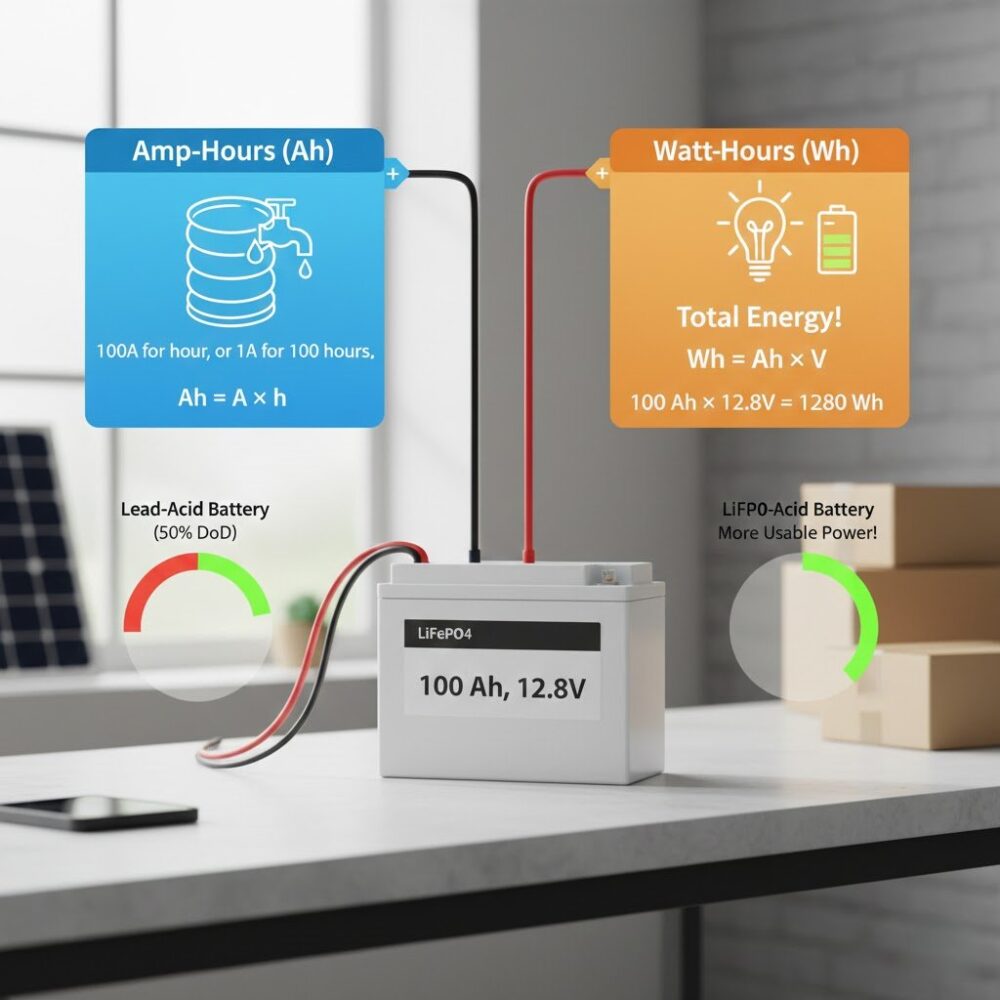
Decoding the Ah Formula and Practical Meaning
The definition of Amp-Hours is straightforward, rooted in a simple physical formula that combines current (Amperes) and time (Hours).
The Basic Ah Formula
A battery’s Amp-Hour rating indicates the amount of current it can supply for one hour before its voltage drops to an unacceptable level.
Amp-Hours (Ah) = Current (A) × Time (h)
For example, a battery rated at 100Ah theoretically means it can deliver 100 Amperes of current for 1 hour, or 1 Ampere of current for 100 hours.
Putting Ah into Practice
Let’s apply this definition using a practical scenario to better illustrate the Amp-Hours concept:
Imagine you have a 100Ah battery installed in your mobile power system. If you run a small DC appliance that draws 5 Amperes of current, the basic calculation suggests:
Runtime = 100 Ah / 5 A = 20 Hours
The appliance should run for 20 hours. This simple calculation gives you a baseline for planning your energy consumption.
The C-Rating Standard (Authority Check)
You must understand that a battery’s Ah rating is not always a fixed number. Manufacturers rate capacity based on specific C-Ratings, which reflect the rate of discharge.
Most Deep Cycle batteries (including lead-acid) are rated using the C/20 standard. This means the 100Ah rating was determined by discharging the battery steadily over 20 hours. If you discharge the battery faster (e.g., in 5 hours), the actual usable Ah capacity will often be lower due to internal resistance and chemistry effects.
The Crucial Difference: Ah vs. Wh (Capacity vs. Energy)
When you are discussing energy storage, you often see both Ah and Wh ratings. It is essential to distinguish between these two terms.
Ah is Capacity; Wh is Energy
- Amp-Hours (Ah): Measures how much current the battery can deliver, regardless of voltage. It is a capacity measurement.
- Watt-Hours (Wh): Measures the battery’s total stored energy. It accounts for both current and voltage.
The Watt-Hour calculation is arguably the most important metric for comparing different energy sources because it represents the actual useful work the battery can do.
Watt-Hours (Wh) = Amp-Hours (Ah) \ Nominal Voltage (V)
For instance, a 100Ah, 12V battery stores 1200Wh of energy. However, a 100Ah, 24V battery stores 2400Wh of energy. When comparing energy solutions, Watt-Hours provides the true picture of total power available.
If you are calculating the actual battery capacity, always convert to Wh to get the most accurate and universal figure.
The Real Factors Influencing Usable Ah
The basic formula provides a theoretical maximum. In the real world, the actual runtime of a battery is always less than the theoretical calculation due to internal design and safety requirements. Our industry experience confirms that two factors dominate this reduction.
Influence 1: Depth of Discharge (DoD)
The Depth of Discharge (DoD) is the safe percentage of the total stored energy you can consistently remove from the battery without damaging its long-term health. This is the single largest variable affecting your usable Ah.
- Lead-Acid/AGM Limitations: To protect its lifespan, a traditional lead-acid or AGM battery should ideally never be discharged beyond a 50% DoD. This means a 100Ah lead-acid battery offers only 50 Ah of usable capacity. Pushing past 50% severely shortens its cycle life.
- LiFePO4 Superiority: In contrast, Lithium Iron Phosphate (LiFePO4) batteries are engineered to withstand deep cycling. You can safely and repeatedly discharge these batteries to 80% or even 90% DoD without significant degradation.
This DoD difference is crucial when planning your system. A battery’s advertised Ah rating means very little if you can only safely use half of it.
Influence 2: The Peukert Effect (High Discharge Rates)
The German scientist W. Peukert discovered that as the current drawn from a battery increases (faster discharge), its actual usable Ah capacity decreases. This is known as the Peukert Effect.
The higher the discharge rate, the shorter the runtime compared to the C/20 rating. If you run a high-draw appliance (like a large inverter or microwave), you are subject to this capacity loss.
- Impact on Traditional Batteries: The Peukert Effect significantly impacts lead-acid chemistry due to internal resistance and sulfuric acid concentration limitations. The faster you drain it, the less Amp-Hours you get.
- Impact on LiFePO4: LiFePO4 chemistry boasts very low internal resistance. Therefore, lithium batteries are much less susceptible to the Peukert Effect. This is a critical advantage for systems requiring high instantaneous power, meaning their usable battery capacity remains high even under heavy load.
LiFePO4 Batteries: Maximizing Your Amp-Hours
When considering what does the Ah mean on a battery in terms of real-world performance, the discussion inevitably leads to battery chemistry. LiFePO4 technology fundamentally changes how you utilize the capacity you purchase.
Higher Usable Ah Capacity
If you purchase a 100Ah LiFePO4 battery versus a 100Ah lead-acid battery, your available Amp-Hours for running appliances is almost double.
This increase in usable capacity translates directly into extended autonomy and reduced need for oversized battery banks. You get more actual work for every Amp-Hour sticker rating.
| Battery Type | Nominal Ah Rating | Safe DoD | Usable Ah Capacity | Increase in Runtime |
| Lead-Acid | 100 Ah | 50% | 50 Ah | Baseline (1.0x) |
| LiFePO4 | 100 Ah | 90% | 90 Ah | 80% More Runtime |
Consistency and Longevity
Beyond sheer capacity, the consistency of LiFePO4 contributes to long-term cost savings.
- Stable Voltage: LiFePO4 maintains a very stable voltage throughout the majority of its discharge cycle, enhancing the efficiency of the attached inverter and protecting connected electronics.
- Extended Cycle Life: Lithium batteries offer significantly higher cycle life (often 4,000 to 6,000 cycles) compared to lead-acid batteries (typically 500 to 1,000 cycles). This means you can use the maximum available Amp-Hours explained by the LFP battery for many years without worrying about frequent replacement.
Making an Informed Battery Choice
The answer to what does the Ah mean on a battery is more complex than just a number printed on a label. Ah is a starting point, but the true value lies in the usable Amp-Hours you can safely extract.
To make an informed decision for your power system, you must consider the crucial correction factors: the safe Depth of Discharge and the negligible impact of the Peukert Effect. When you prioritize long-term performance and extended runtime, high-quality LiFePO4 storage systems provide substantially more usable energy.
Choosing a vendor with a deep understanding of these technical nuances ensures you maximize your investment. Contact our experts today to design a system that delivers reliable, long-lasting power based on your specific energy needs.