
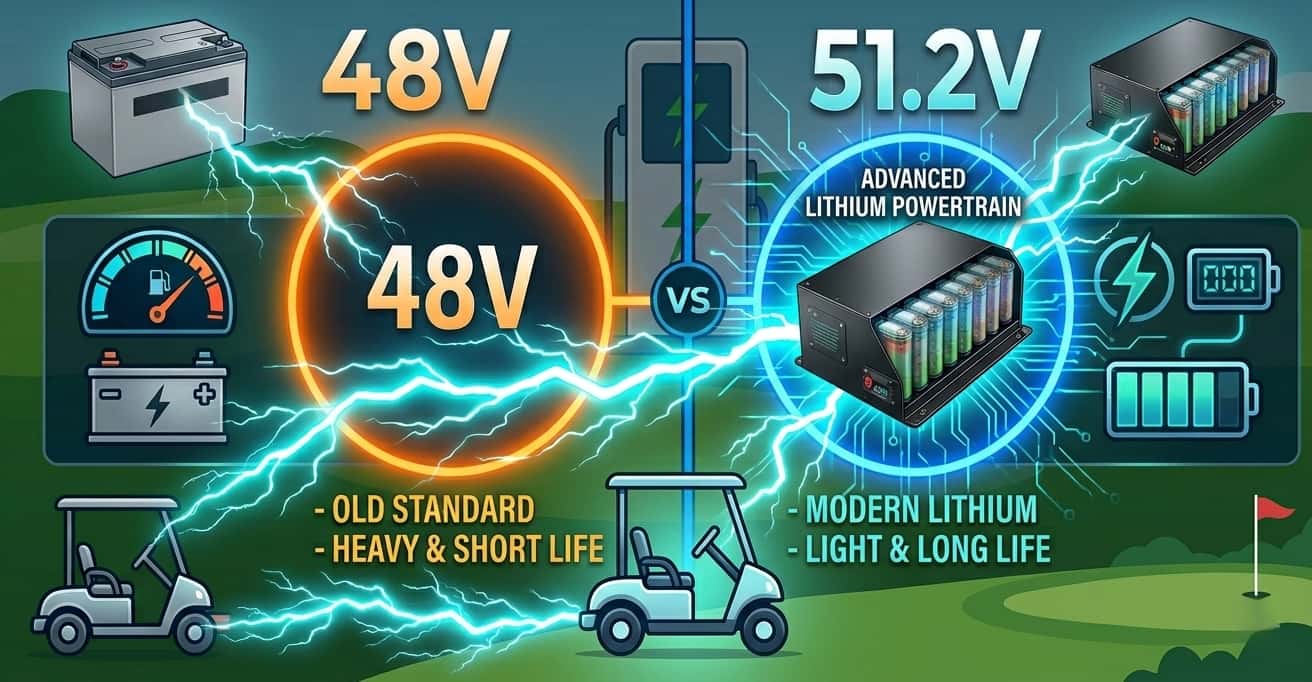
What’s the Difference Between 48V and 51.2V Golf Cart Batteries?
When upgrading your golf cart battery system, especially when transitioning from traditional lead-acid to modern lithium technology, you will likely come across two primary voltage options: 48V and 51.2V.
At first glance, the difference seems minor. However, understanding the technical and performance distinctions between a 48V and a 51.2V golf cart battery is crucial for maximizing your vehicle’s efficiency, range, and overall lifespan.
Here is a detailed breakdown of the differences and why 51.2V has become the premium standard for modern electric golf carts.
1. Cell Configuration: 15S vs. 16S
The primary difference between a 48V and a 51.2V lithium battery lies in the internal cell configuration. Most high-performance lithium golf cart batteries use Lithium Iron Phosphate (LiFePO4) chemistry. A single LiFePO4 cell has a nominal voltage of 3.2V.
- 48V Lithium Batteries: These are typically configured with 15 cells connected in series (known as a 15S configuration). 15 cells x 3.2V equals a nominal voltage of 48V.
- 51.2V Lithium Batteries: These are configured with 16 cells connected in series (known as a 16S configuration). 16 cells x 3.2V equals a nominal voltage of 51.2V.
By adding that 16th cell, manufacturers create a fundamentally more robust power source that better matches the true operational needs of heavy-duty electric vehicles.
2. Higher Energy Capacity and Range
Battery capacity is measured in Watt-hours (Wh), which is calculated by multiplying the voltage by the Amp-hours (Ah).
Let’s compare a 48V 100Ah battery with a 51.2V 100Ah battery:
- 48V x 100Ah = 4,800 Watt-hours (4.8 kWh)
- 51.2V x 100Ah = 5,120 Watt-hours (5.12 kWh)
Even though both batteries have the same 100Ah rating, the 51.2V battery provides 6.6% more total energy. In practical terms, this translates directly into a longer driving range per charge and more runtime on the golf course or in commercial settings.
3. Sustained Power and Better Hill Climbing
Traditional lead-acid batteries suffer from “voltage sag”—as the battery discharges, the voltage drops significantly, causing the golf cart to slow down, especially when climbing hills or carrying heavy loads.
While all lithium batteries maintain a much flatter discharge curve than lead-acid, the 51.2V (16S) configuration provides a distinct advantage over the 48V (15S) version:
- Higher Voltage Plateau: The 51.2V pack maintains a higher voltage throughout its discharge cycle.
- Consistent Torque: This higher sustained voltage provides the motor with consistent power, resulting in better acceleration, higher top speeds, and superior torque for climbing steep inclines, even when the battery charge is low.
4. Compatibility: Can You Use a 51.2V Battery in a 48V Golf Cart?
Yes. This is the most common question from golf cart owners. Standard 48V golf cart controllers and motors (from major brands like Club Car, EZGO, and Yamaha) are designed to handle a specific voltage range, not just a rigid 48V.
A standard 48V lead-acid battery pack actually reaches around 54.4V when fully charged. A 51.2V lithium battery typically charges up to a maximum of 58.4V. This falls safely within the operational tolerance limits of traditional 48V speed controllers and motors, making a 51.2V lithium battery a seamless, direct drop-in replacement.
Why Choose Lefor 51.2V Lithium Battery Solutions?
As a specialist in advanced energy storage systems, Lefor Energy Storage engineers premium 51.2V LiFePO4 battery solutions specifically tailored for high-demand applications.
- Grade A Cells: Lefor utilizes high-density, automotive-grade LiFePO4 cells to ensure maximum safety, thermal stability, and an extended lifespan of over 4,000 cycles.
- Mature 16S BMS Architecture: Our integrated Smart Battery Management System (BMS) is optimized for 16S configurations, delivering precise cell balancing, overcharge protection, and highly accurate State of Charge (SoC) reporting.
- Factory-Direct Reliability: Built to international B2B quality standards, Lefor solutions provide global fleet operators and distributors with reliable, high-efficiency power that outlasts and outperforms traditional 15S setups.
Conclusion
While a 48V lithium battery is a decent upgrade from lead-acid, choosing a 51.2V lithium battery gives you the advantage of a true 16S industrial-grade configuration. With more usable energy, sustained power on tough terrains, and perfect compatibility with existing 48V systems, 51.2V is the superior choice for long-term value and performance.