
51.2V Battery and Inverter Compatibility: 8 Checks Before You Order
The eight checks before you order
| # | Compatibility check | Evidence to request |
|---|---|---|
| 1 | Battery operating-voltage range | Approved battery and inverter data sheets |
| 2 | Charge-voltage/current limits | Manufacturer profile or settings sheet |
| 3 | Continuous and surge discharge current | Load study and both product ratings |
| 4 | LiFePO4 chemistry and reserve behavior | Approved charging mode and low-SoC plan |
| 5 | CAN or RS485 protocol | Exact inverter model/firmware compatibility list |
| 6 | Communication cable pinout | Wiring drawing and cable part number |
| 7 | Firmware and selected battery profile | Commissioning screenshot and version record |
| 8 | Parallel topology and protection | Single-line diagram, address and protection plan |
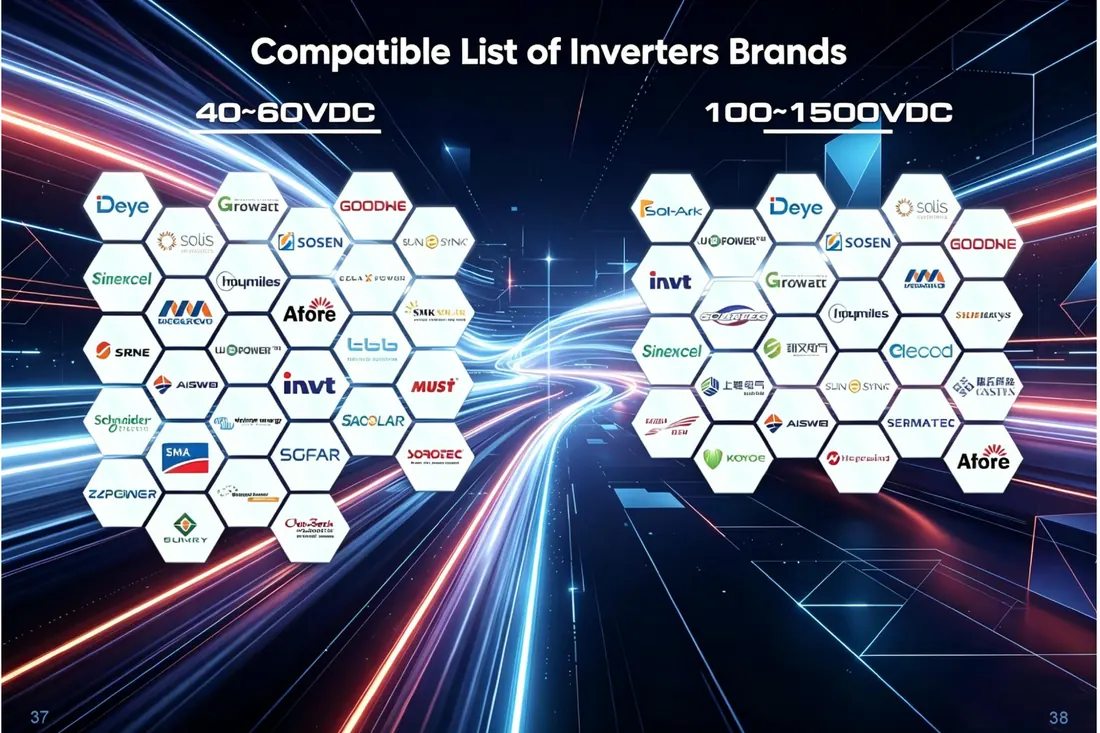
Electrical compatibility: voltage and current
Compare the full operating range, not just “48V” or “51.2V.” Confirm maximum charge voltage, low-voltage stop behavior and any inverter pre-charge requirement.
Approximate DC current = AC output power ÷ battery voltage ÷ inverter efficiency
A 10kW load can require more than 195A from a 51.2V bank after losses. The battery, breakers, busbars and cables must all support the planned current with margin.
Communication compatibility: protocol and pinout
- Exact inverter model and firmware are listed as supported.
- Battery BMS profile is selected correctly.
- CAN/RS485 pins, polarity and termination match.
- Parallel batteries have unique addresses and an approved master unit.
- Loss of communication produces a safe fallback or shutdown.
Commissioning acceptance checklist
- Confirm polarity, torque, isolation and protection before energizing.
- Record firmware, battery profile, voltage/current limits and reserve.
- Verify correct SoC, voltage, current and temperature on both devices.
- Test charging, discharging, low-SoC behavior and recovery.
- Test a communication interruption and confirm safe response.
- Save final settings, BMS/inverter logs and the signed handover sheet.
Frequently asked questions
Will any 48V inverter work with a 51.2V LiFePO4 battery?
No. The operating range, charging settings, current and communication must match the exact products.
Is CAN better than RS485 for compatibility?
Neither interface guarantees compatibility. Use the method approved by both manufacturers with the correct protocol, firmware and cable.
Can I run without BMS communication?
Some approved systems can use voltage-based control, but protection and SoC behavior differ. Obtain written approval and settings from both manufacturers.
What information should I send for confirmation?
Inverter brand, exact model, firmware, battery energy/current target, phase, load power and photos of the communication labels/ports.
Sources and further reading
Compatibility is model- and firmware-specific. Follow approved manuals, manufacturer confirmation, local code and qualified commissioning procedures.