5kWh–32kWh 48V LiFePO4 Battery Solutions for Residential and Commercial Energy Storage
5kWh–32kWh 48V LiFePO4 Battery Solutions for Residential and Commercial Energy Storage
Quick Answer
Choosing the right battery capacity is one of the most important decisions when designing a solar energy storage system. From compact 5kWh residential batteries to larger 32kWh systems, different capacity ranges can meet different energy storage and backup requirements.
48V-class LiFePO4 batteries have become a practical solution for residential and small commercial energy storage because they combine long cycle life, stable battery chemistry, scalability, and compatibility with many low-voltage solar inverters.
For homeowners, installers, distributors, and system integrators, a modular 5kWh–32kWh battery portfolio provides flexibility to design energy storage systems according to actual electricity consumption, backup requirements, and future energy demand.
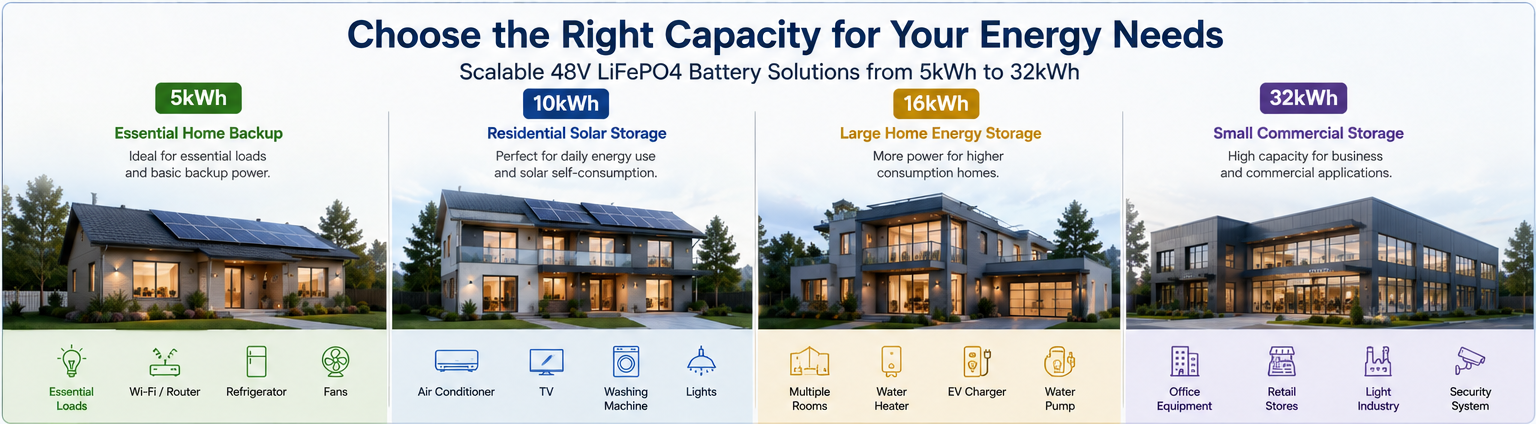
5kWh
A compact energy storage solution for essential residential loads and basic
backup power applications.
10kWh
A balanced capacity for residential solar energy storage and daily energy
consumption.
16kWh
Suitable for larger homes and applications requiring greater energy storage
capacity.
32kWh
Designed for large residential systems and small commercial energy storage
applications.
Why Choose 48V LiFePO4 Batteries for Energy Storage?
Battery energy storage systems need to operate reliably over many years. Therefore, battery chemistry, voltage, capacity, communication, and inverter compatibility are all important considerations when selecting an energy storage solution.
Lithium iron phosphate, commonly known as LiFePO4 or LFP, has become one of the most widely used lithium battery chemistries for solar energy storage.
Compared with many other lithium battery chemistries, LiFePO4 provides a strong combination of safety, cycle life, thermal stability, and cost efficiency.
A 48V-class battery architecture also provides a practical solution for many residential and small commercial solar systems, particularly when paired with compatible hybrid or off-grid inverters.
- Long Cycle Life: LiFePO4 chemistry is designed for repeated charge and discharge operation over long-term energy storage applications.
- Stable Chemistry: LiFePO4 offers strong thermal and chemical stability for demanding energy storage applications.
- Scalable Capacity: Modular battery configurations allow installers to design systems with different energy capacities.
- Solar System Compatibility: 48V-class batteries can be integrated with compatible low-voltage hybrid and off-grid solar inverters.
- Smart Communication: CAN and RS485 communication can help integrate the battery with compatible inverters and energy management systems.
Choosing the Right Battery Capacity: 5kWh to 32kWh
Battery capacity should not be selected based only on the size of the solar system. The correct capacity depends on electricity consumption, required backup time, inverter power, solar PV capacity, and future energy demand.
The following capacity ranges provide a general reference for residential and small commercial energy storage applications.
| Battery Capacity | Typical Application | Recommended Use |
|---|---|---|
| 5kWh | Basic residential energy storage | Essential loads, backup power, small solar systems |
| 10kWh | Residential solar storage | Daily energy shifting, home backup, solar self-consumption |
| 16kWh | Large residential energy storage | Higher household consumption and longer backup periods |
| 32kWh | Large residential and small commercial storage | Higher energy demand, commercial backup, solar energy storage |
5kWh LiFePO4 Battery: Compact Residential Energy Storage
A 5kWh LiFePO4 battery is a practical starting point for homeowners who want to add battery storage to a solar energy system.
The battery can store excess solar energy generated during the day and provide stored electricity when solar production is low or when backup power is required.
Typical applications include:
- Home backup power
- Solar self-consumption
- Essential household loads
- Small off-grid solar systems
- Compact residential energy storage
10kWh LiFePO4 Battery: A Balanced Home Energy Storage Solution
For homes with higher electricity consumption, a 10kWh LiFePO4 battery provides additional energy storage capacity for daily solar energy utilization and backup power.
A typical solar energy storage system can operate according to the following energy flow:
Solar Panels → Hybrid Inverter → LiFePO4 Battery → Household Loads
During the day, solar energy can supply household loads while excess energy is stored in the battery. At night or during a grid outage, stored energy can be used to support household electricity demand.
16kWh LiFePO4 Battery: More Energy for Larger Homes
A 16kWh battery storage system is suitable for larger residential applications or homes with higher electricity consumption.
The additional storage capacity can provide greater flexibility for applications such as:
- Air conditioning
- Refrigeration
- Water pumps
- Home office equipment
- Electric vehicle charging support
- Longer backup periods
For installers, stackable battery configurations can provide additional flexibility when designing systems for different household energy requirements.
32kWh LiFePO4 Battery: Residential and Small Commercial Storage
When energy requirements increase, 32kWh of battery storage can provide a larger energy reserve for large residential and small commercial applications.
Potential applications include:
- Large residential energy storage
- Small businesses
- Retail stores and offices
- Backup power systems
- Solar self-consumption
- Small commercial solar systems
For commercial projects, a modular battery architecture allows installers and system integrators to configure the storage capacity according to actual energy requirements rather than relying on a single fixed battery size.

How Does a 48V LiFePO4 Battery Work with a Solar Inverter?
Battery and inverter compatibility is one of the most important considerations when designing a solar energy storage system.
A typical low-voltage solar storage system may use a 48V-class LiFePO4 battery together with a compatible hybrid or off-grid inverter.
The basic system architecture can be represented as:
PV → Hybrid Inverter → 48V LiFePO4 Battery → Load / Grid
During periods of strong solar production, photovoltaic energy can supply the loads while excess electricity is stored in the battery.
When solar production decreases, the stored energy can be discharged to support the loads.
During a grid outage, a properly configured backup system can use the battery and inverter to provide power to designated loads.
The exact operating mode depends on the inverter configuration, battery management system, local electrical regulations, and system design.
How to Choose the Right LiFePO4 Battery Capacity
The right battery capacity depends on the actual energy requirements of the project rather than simply choosing the largest available battery.
1. Daily Electricity Consumption
Start by estimating how much electricity the home or business consumes during a typical day.
2. Required Backup Duration
Determine how long the battery needs to support essential loads during a grid outage.
3. Inverter Capacity
The battery should be properly matched with the inverter’s voltage, charging and discharging requirements, communication protocol, and power rating.
4. Solar PV Capacity
A larger solar array can generate more excess electricity that can be stored in the battery for later use.
5. Future Energy Demand
If electricity consumption is expected to increase, a modular and expandable battery system can provide greater flexibility for future system upgrades.
Why Modular LiFePO4 Battery Solutions Matter for Installers
One battery capacity cannot meet every energy storage requirement. Residential homes, commercial buildings, and backup power projects often have very different energy profiles.
A modular battery portfolio covering 5kWh, 10kWh, 16kWh, and 32kWh gives installers more flexibility when designing different solar energy storage projects.
- 5kWh: Essential home backup
- 10kWh: Residential solar energy storage
- 16kWh: High-consumption residential storage
- 32kWh: Large residential and small commercial storage
This approach allows distributors and system integrators to offer different solutions while maintaining a consistent battery technology platform.

What Should B2B Buyers Consider When Selecting a LiFePO4 Battery?
For installers, distributors, and system integrators, battery capacity is only one part of the purchasing decision.
Important technical and commercial factors include:
- Battery voltage
- Nominal capacity
- Usable energy
- Maximum charging current
- Maximum discharge current
- Cycle life
- Battery Management System (BMS)
- CAN / RS485 communication
- Inverter compatibility
- Operating temperature
- Installation method
- Scalability
- Warranty
- OEM and customization capabilities
For B2B buyers, system compatibility and long-term reliability can be just as important as nominal battery capacity.
A battery that integrates smoothly with the inverter and can be expanded for future projects can help installers reduce system design complexity and offer more flexible solutions to their customers.
48V LiFePO4 Battery Applications in Residential and Commercial Energy Storage
48V-class LiFePO4 batteries can be used across a wide range of solar energy storage applications.
Residential Solar Energy Storage
Residential systems can use LiFePO4 batteries to store excess solar energy, reduce reliance on grid electricity, and provide backup power during outages.
Home Backup Power
In regions with unstable electricity grids or frequent power interruptions, battery storage can provide additional energy security for essential household loads.
Small Commercial Energy Storage
Small businesses, offices, shops, and other commercial facilities can use larger battery capacities to improve solar self-consumption and provide backup power.
Off-Grid Solar Systems
In locations without reliable grid access, LiFePO4 batteries can store solar energy and provide electricity when photovoltaic generation is unavailable.
LiFePO4 Battery Solutions for Different Energy Storage Requirements
The most suitable battery system depends on the project’s electricity consumption, required backup duration, solar generation, and future expansion requirements.
A flexible 5kWh–32kWh product portfolio allows installers to provide solutions for different project sizes without relying on a single battery configuration.
| Capacity | Application | System Objective |
|---|---|---|
| 5kWh | Small residential | Essential backup and solar self-consumption |
| 10kWh | Residential | Daily solar storage and backup power |
| 16kWh | Large residential | Higher energy consumption and extended backup |
| 32kWh | Residential / Small commercial | Large energy storage and commercial backup |
Why Choose LeforESS LiFePO4 Battery Solutions?
LeforESS provides 48V-class LiFePO4 battery energy storage solutions covering multiple capacities for residential, commercial, and renewable energy applications.
Our battery portfolio is designed to provide flexible options for installers, distributors, system integrators, and OEM partners.
Depending on the application, customers can select different battery capacities and configurations to build energy storage systems according to their project requirements.
Scalable Energy Storage
Battery capacities from 5kWh to 32kWh support different residential and
commercial energy storage requirements.
48V-Class Architecture
Designed for integration with compatible low-voltage solar inverter systems.
LiFePO4 Chemistry
Provides a strong combination of safety, cycle life, reliability, and cost
efficiency.
B2B-Oriented Solutions
Flexible configurations and OEM capabilities support installers, distributors,
and system integrators worldwide.
Frequently Asked Questions
What size LiFePO4 battery do I need for a home solar system?
The required battery capacity depends on household electricity consumption, solar PV capacity, inverter power, and desired backup duration. A 5kWh system may be suitable for essential loads, while 10kWh, 16kWh, or 32kWh systems can support larger energy requirements.
What is a 48V LiFePO4 battery?
A 48V LiFePO4 battery is a lithium iron phosphate battery designed around a 48V-class nominal system architecture. Many modern residential solar storage systems use this voltage range together with compatible hybrid or off-grid inverters.
Is a 51.2V battery the same as a 48V battery?
Many modern LiFePO4 battery systems marketed as 48V-class batteries use a nominal voltage of approximately 51.2V. However, compatibility should always be confirmed based on the specific inverter and battery specifications.
Can LiFePO4 batteries be used with solar inverters?
Yes. LiFePO4 batteries can be integrated with compatible hybrid, off-grid, and energy storage inverters. Voltage range, charging parameters, communication protocols, and BMS compatibility should be confirmed before installation.
Can a LiFePO4 battery system be expanded later?
Some modular battery systems are designed for parallel or stackable expansion. The maximum number of battery modules and expansion configuration depend on the specific battery and inverter system.
Are LiFePO4 batteries suitable for commercial energy storage?
Yes. LiFePO4 batteries can be used for small commercial energy storage, backup power, solar self-consumption, and other distributed energy storage applications. Larger projects require detailed system sizing and electrical design.
Build Reliable Solar Energy Storage Solutions with LeforESS
From compact 5kWh residential batteries to larger 32kWh energy storage systems, the right battery capacity can help homeowners, installers, and businesses build more flexible solar energy storage solutions.
LeforESS provides 48V-class LiFePO4 battery solutions for residential, commercial, and renewable energy storage applications, with flexible capacities, modular configurations, and OEM support.
Whether you are looking for residential solar batteries, commercial energy storage solutions, OEM battery manufacturing, or customized LiFePO4 battery systems, LeforESS can support your project with professional engineering and manufacturing capabilities.
Contact LeforESS for Energy Storage Solutions