Micro Inverter vs. String Inverter: Which One is the Best Partner for Your Energy Storage System?
Choosing the right solar inverter is like choosing the “brain” for your solar energy system. However, for many homeowners and installers, the debate between Micro Inverters and String Inverters can be confusing.
If you are also planning to integrate an Energy Storage System (ESS), this choice becomes even more critical. In this guide, we’ll break down the differences, pros, and cons to help you decide which one fits your energy needs.
1. What is a String Inverter?
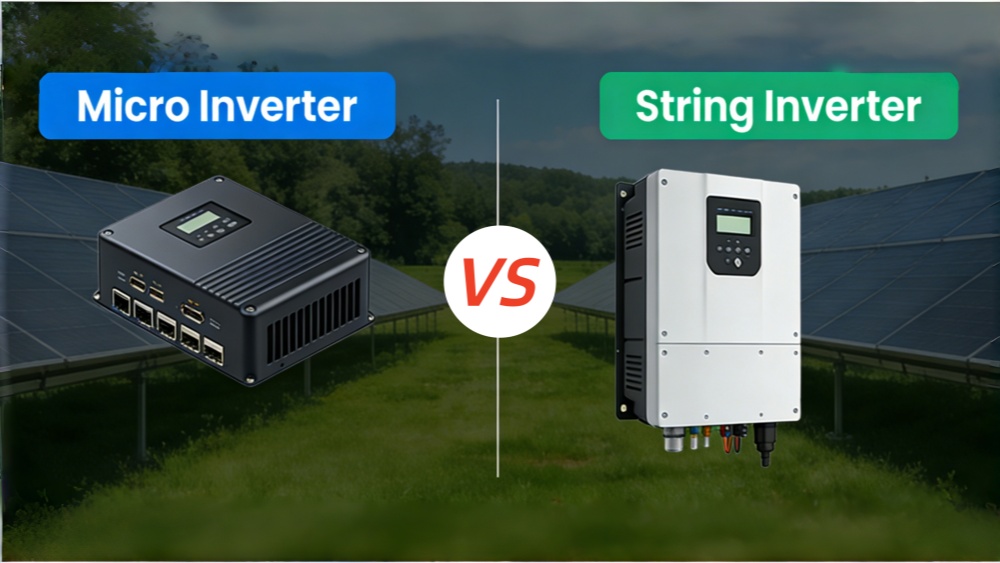
A String Inverter is the traditional choice. In this setup, several solar panels are connected in a “string” (series), and the combined DC electricity is sent to a single large inverter installed on the side of your house or in a garage.
- Pros: Lower upfront cost, easier maintenance (accessible location), and high reliability for simple roof designs.
- Cons: The “Christmas Light” effect. If one panel is shaded or dirty, the performance of the entire string drops to the level of the weakest panel.
2. What is a Micro Inverter?
A Micro Inverter is a small device installed on the back of each individual solar panel. It converts DC to AC right at the source.
- Pros: Maximum efficiency. Since each panel operates independently, shade on one panel won’t affect the others. It’s also easier to expand your system later.
- Cons: Higher initial cost and more complex installation (since you have many small units on the roof).
Head-to-Head Comparison
| Feature | String Inverter | Micro Inverter |
| Initial Cost | Lower (Budget-friendly) | Higher |
| System Efficiency | High (in full sun) | Excellent (even in shade) |
| Scalability | Harder to add panels | Very easy to expand |
| Monitoring | System-level only | Panel-level monitoring |
| Lifespan | 10–15 years | 20–25 years |
3. Why Your Inverter Choice Matters for Battery Storage
Whether you choose a micro or string inverter, the ultimate goal for most modern users is Energy Independence. This is where your Energy Storage Battery comes into play.
For String Inverters:
Most string setups use Hybrid Inverters. These are “battery-ready,” meaning they can manage both your solar panels and your battery bank (like a high-capacity LiFePO4 battery) in one unit. It is an efficient, DC-coupled solution that reduces energy conversion loss.
For Micro Inverters:
Micro inverter systems typically use AC-coupled storage. This means the energy is converted from DC to AC on the roof, then back to DC to be stored in the battery. While slightly less efficient in conversion, it offers incredible flexibility—you can add a battery to almost any existing micro-inverter system without rewiring the whole array.
4. The Secret Ingredient: High-Quality LiFePO4 Batteries
Regardless of the inverter technology you choose, your system is only as good as its ability to store power for the night or during a blackout.
As a professional Energy Storage Battery manufacturer, we recommend pairing your inverter with Grade-A LiFePO4 (Lithium Iron Phosphate) cells. Why?
- Safety: LiFePO4 is thermally stable and the safest lithium chemistry available.
- Longevity: With over 6,000+ deep cycles, our batteries can last 10–15 years.
- Compatibility: Our battery solutions are designed to communicate seamlessly with major hybrid and off-grid inverter brands.
Pro Tip: If you are building a system today, always choose a battery with a high-quality BMS (Battery Management System) to ensure it can handle the specific discharge rates of your chosen inverter.
Final Verdict: Which One Should You Choose?
- Choose a String Inverter if: You have a clear, unshaded roof and are looking for the most cost-effective way to power your home and charge your batteries.
- Choose a Micro Inverter if: Your roof has a complex shape, experiences partial shading, or if you plan to start small and expand your solar capacity in the future.
Ready to power up your home? At LeforEss, we provide premium energy storage solutions tailored to your specific inverter setup. From wall-mounted home batteries to stackable high-voltage systems, we ensure your solar harvest never goes to waste.
Contact Us Today for a Free Battery Compatibility Consultation!