
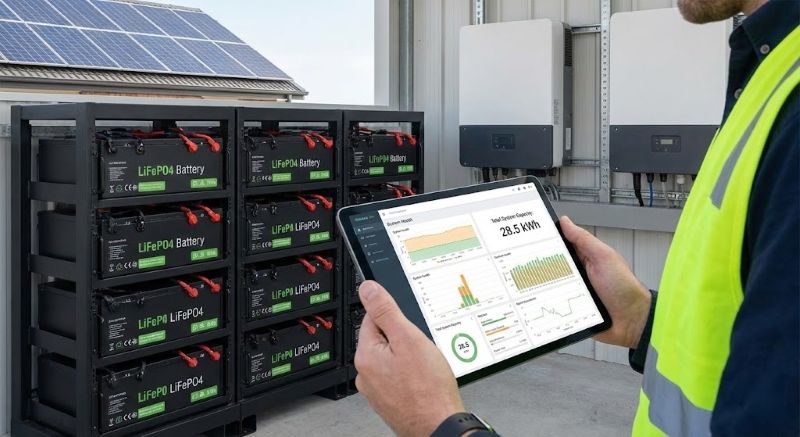
how do you measure the capacity of a battery?
What you need for an acceptance test
- Approved charger or inverter/charger with logged settings.
- Calibrated electronic load or suitable inverter/load bank.
- Voltage, current, energy and temperature logging.
- BMS access for cell voltage, SoC, alarms and cutoff reason.
- Safe enclosure, protection devices and emergency procedure.
Use the manufacturer’s approved current, temperature and cutoff conditions. Do not improvise a deep-discharge test on a damaged, swollen, wet or abnormally hot battery.

Step-by-step LiFePO4 capacity test
- Record model, serial number, firmware, test date and ambient/battery temperature.
- Charge using the approved profile until the documented full-charge condition is reached.
- Allow the battery to rest if the manufacturer’s method requires it.
- Discharge at the specified constant current or power while logging voltage, current and temperature.
- Stop at the documented end condition—not by repeatedly forcing the BMS to reset.
- Calculate Ah and Wh, review cell spread and save the raw curve.
- Recharge promptly using the approved procedure.
Capacity (Ah) = ∫ current (A) × time (h) | Energy (Wh) = ∫ voltage (V) × current (A) × time (h)
What a usable test report includes
| Field | Example of what to record | Why it matters |
|---|---|---|
| Battery identity | Model, serial, cell/BMS revision | Traceability |
| Test conditions | Current/power, temperature, start/end criteria | Fair comparison |
| Instruments | Model, serial and calibration status | Measurement confidence |
| Results | Ah, Wh, duration, average voltage | Capacity and energy |
| BMS data | Minimum/maximum cell, alarms, cutoff reason | Diagnoses imbalance or protection |
| Disposition | Pass/fail threshold and approver | Clear acceptance decision |
Common reasons a result looks too low
- The battery did not reach the defined full-charge condition.
- The discharge current or temperature differed from the specification.
- The inverter stopped early due to settings or communication.
- Voltage drop in cables triggered a premature cutoff.
- The meter counted AC output rather than battery-side DC energy.
- One weak or imbalanced cell reached the BMS limit first.
Frequently asked questions
Should I measure Ah or Wh?
Record both. Ah is useful at a defined voltage, while Wh better represents the energy available to a system as battery voltage changes.
Can I test capacity through the inverter AC output?
It can measure delivered AC energy, but that result includes inverter consumption and efficiency. For battery capacity, record battery-side DC values as well.
What discharge rate should I use?
Use the rate in the approved product specification or acceptance plan. Capacity can change with current and temperature.
Can I stop at BMS shutdown?
Use the documented end-of-test condition. Repeatedly forcing protection cutoff is not a normal operating or acceptance strategy.
Sources and further reading
Battery testing involves high energy and must be completed by qualified personnel with approved procedures, protection and test equipment.