
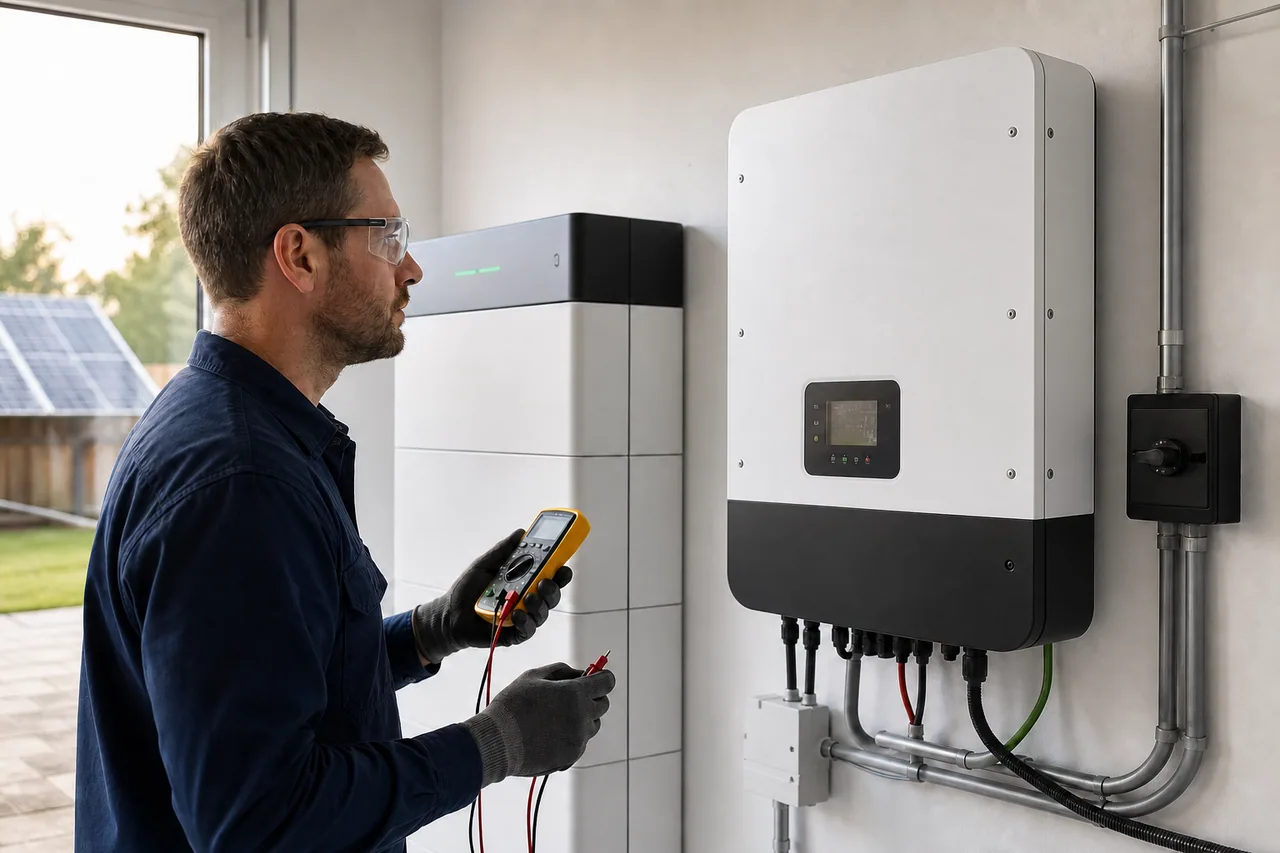
Why My Solar Inverter is Making Beep Sound Continuously: A Troubleshooting Guide
Stop troubleshooting if you see these warning signs
Electrical work should follow the equipment documentation and local rules. The OSHA electrical safety resources explain why qualified-person procedures and protection from energized parts matter.
What does the inverter beep pattern mean?
There is no universal beep dictionary. One manufacturer may use a continuous tone for overload while another uses it for battery shutdown. Treat the table below as a triage guide, then confirm the meaning in the exact model manual.
| What you observe | Likely category | First safe check |
|---|---|---|
| Continuous beep plus red fault light | Active fault, overload, short circuit or internal protection | Photograph the code; disconnect nonessential loads; follow the manual. |
| Beeping when a large appliance starts | Surge load or battery voltage sag | Turn off that appliance and compare its starting demand with inverter and battery limits. |
| Beeping near low state of charge | Low battery warning or BMS cutoff approaching | Reduce load and recharge; do not repeatedly force a restart. |
| Beeping on hot afternoons | High temperature or restricted cooling | Check that vents are clear and the room is within the manual’s temperature range. |
| Intermittent beep after grid loss/return | Mode change, transfer event or grid parameter alert | Check grid status and the event log; do not change grid settings without authorization. |
A safe 7-step troubleshooting sequence
- Observe before touching. Note the time, beep pattern, LEDs, state of charge, load level and whether the grid is present.
- Photograph the screen. Capture the complete fault or warning code; many codes disappear after a reset.
- Check the model label and manual. Use the manual for the exact model and firmware family—not a similar inverter.
- Reduce the load. Switch off high-demand and nonessential appliances at their normal controls. If the alarm stops, investigate overload or surge demand.
- Inspect externally. With no covers removed, look for blocked vents, dust buildup, unusual fan noise, heat, moisture or damaged cables.
- Check battery status. Read the battery/BMS state of charge and warnings. A low-cell disconnect is a last-resort protection, not a routine operating target; see the Victron lithium battery operating guidance for an example.
- Restart only as documented. If no danger signs are present, use the manufacturer’s shutdown and startup order. If the alarm returns, stop resetting and arrange service.
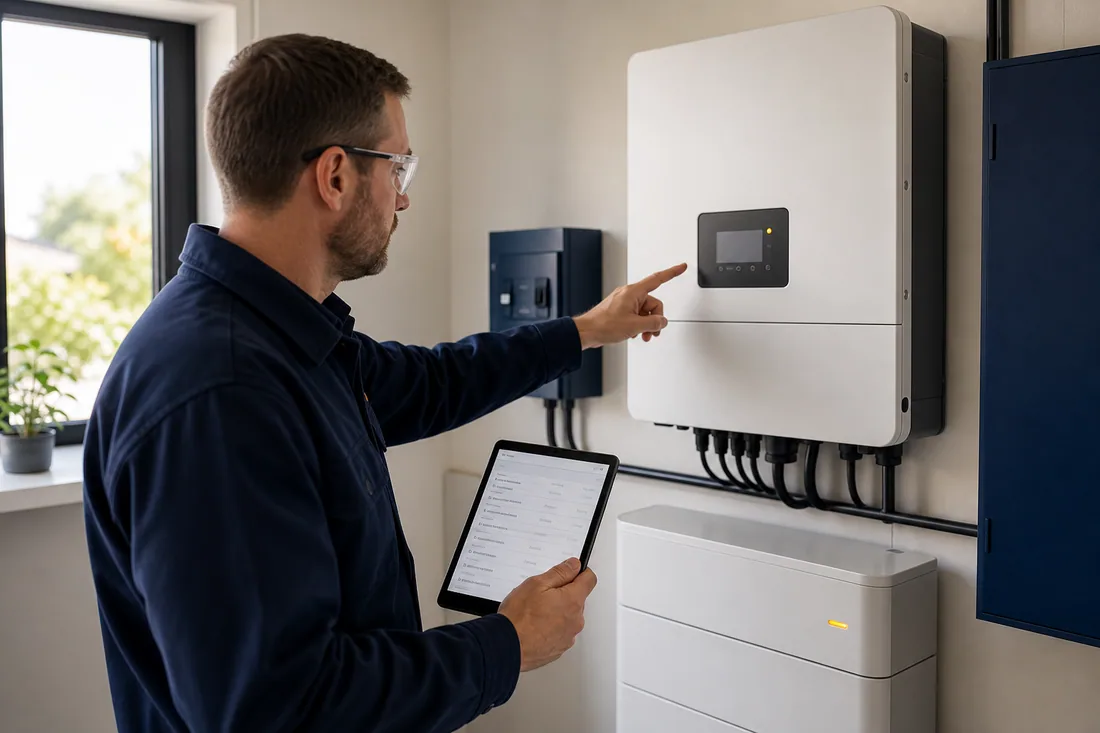
Six common causes of continuous inverter beeping
1. Low battery voltage or low state of charge
The inverter may alarm before the battery management system disconnects the pack. Heavy loads can also pull voltage down temporarily, especially with an undersized, cold, unbalanced or aging battery bank.
What to do: reduce the load, recharge from an approved source and check the BMS event history. If low-voltage alarms occur at a seemingly high state of charge, ask a technician to check cell balance, cable voltage drop and settings compatibility.
2. Output overload or appliance starting surge
Motors, pumps, compressors and some power tools can draw several times their running watts during startup. The display may look normal until the appliance starts.
What to do: turn off nonessential circuits and restart loads one at a time. Compare both continuous watts and surge watts with the inverter specification. If your system regularly needs more headroom, review a correctly sized hybrid inverter.
3. Overtemperature or blocked airflow
Dusty vents, inadequate clearance, a hot equipment room or a failed fan can trigger thermal derating or shutdown.
What to do: keep the exterior vents unobstructed and restore the installation clearances stated in the manual. Do not blow conductive debris into the enclosure or operate with a cover removed.
4. Battery or inverter communication fault
In a lithium system, the inverter and BMS may communicate over CAN or RS485. An incorrect protocol, loose communication plug or incompatible firmware can generate alarms even when the power cables look normal.
What to do: record communication codes and have the installer confirm the supported protocol, termination, pinout and firmware versions.
5. Grid input or transfer problem
Out-of-range grid voltage/frequency, a transfer event or an input wiring problem can cause warnings. Grid parameters are safety settings and should not be widened simply to silence an alarm.
What to do: check whether neighbors also lost power, review the event log and involve a qualified installer or utility when the grid code repeats.
6. Internal fault, fan failure or sensor error
A persistent fault with normal load, temperature, battery and grid conditions may require component-level service.
What to do: stop repeated resets. Send the installer the model, serial number, code, event time, photos and a short video of the beep pattern.
How to prevent the alarm from returning
- Keep sustained and surge loads within both inverter and battery limits.
- Use cable sizes, protection devices and torque values specified by the system designer.
- Maintain required airflow and keep the equipment area dry and uncluttered.
- Review event logs instead of clearing warnings without a record.
- Keep inverter, battery and BMS firmware/settings compatible.
- Schedule inspection when an alarm repeats, even if a restart temporarily clears it.
Planning a complete backup upgrade? Start with the home battery backup options and match capacity to a correctly sized 3.6–5kW hybrid inverter where appropriate.
Frequently asked questions
Why is my solar inverter beeping continuously?
A continuous alarm commonly indicates a condition that needs attention, such as low battery voltage, overload, overheating, a fan problem or another fault. The display code and the model manual are the decisive references.
Can I stop the inverter beep by restarting it?
A restart may clear a temporary condition but should not conceal a recurring fault. Record the code first, remove nonessential loads and follow the shutdown and restart order in the exact model manual.
Why does the inverter beep only when an appliance starts?
The appliance may have a high starting surge, or the battery voltage may sag under load. Compare appliance starting watts with inverter surge capability and confirm that the battery can supply the required current.
Is a beeping inverter dangerous?
Some alarms are notifications; others indicate a condition that can damage equipment or create a risk. Heat, odor, smoke, water exposure, visible damage or repeated tripping requires immediate professional attention.
Sources and further reading
- U.S. Occupational Safety and Health Administration — Electrical safety
- Victron Energy — Lithium Battery Smart operation guidance
This guide is general information, not a substitute for the manual, local electrical code or work by a qualified person. Alarm meanings and shutdown sequences vary by model.