

how do you measure the capacity of a battery?
Understanding your energy storage limits starts with one core metric: battery capacity. Whether you are managing a massive 14kW solar array or checking a small backup cell, knowing how much energy a battery actually holds—rather than what the label claims—is vital for system reliability.
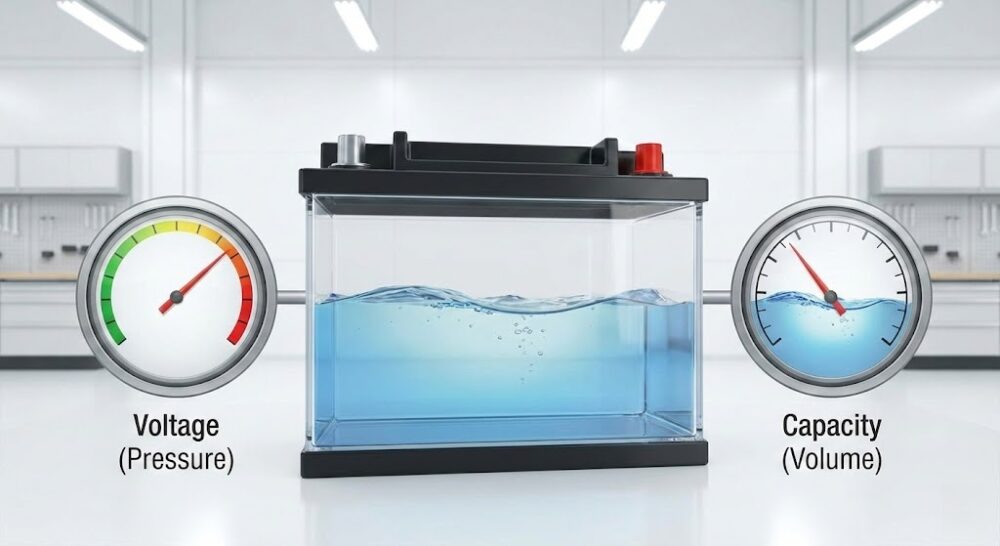
Think of capacity as the “fuel tank” size of your electrical system. While voltage tells you the pressure of the electricity, the capacity tells you the volume. In this guide, we will break down the professional methods to measure this value accurately.
The Fundamentals: Amps, Hours, and Watts
Before grabbing your tools, you must understand the units involved. We typically measure battery capacity in Amp-hours (Ah). This represents the amount of current a battery can deliver over a specific period.
For example, a 100Ah battery should theoretically deliver 5 Amps of current for 20 hours. However, in the real world, discharge rates and chemistry significantly impact these numbers.
To find the total energy in Watt-hours (Wh), you simply multiply the capacity by the nominal voltage (V × Ah). This calculation helps you compare different battery types, such as 12V lead-acid versus 48V lithium systems.
The Discharge Test: The Gold Standard
The most reliable way to measure the battery capacity is the controlled discharge test. This involves draining a fully charged battery at a constant rate until it reaches its “cut-off voltage.”
Step 1: Fully Charge the Battery
Ensure your battery is at 100% State of Charge (SOC). For lithium iron phosphate (LiFePO4) batteries, this usually means charging until the current tapers off at (for a 12V system).
Step 2: Connect a Constant Load
Use a dedicated battery capacity tester or a known resistive load. If you use a 10A load on a 100Ah battery, the test should ideally last 10 hours.
Step 3: Track the Time
Start your timer and monitor the voltage. Stop the test the moment the battery reaches its safe discharge limit (typically for lead-acid or for lithium).
Step 4: Calculate the Result
Multiply the discharge current by the elapsed time. If the battery delivered 9.5 Amps for 10 hours, your actual battery capacity is 95Ah.
Using Smart Tools: Multimeters vs. Coulometers
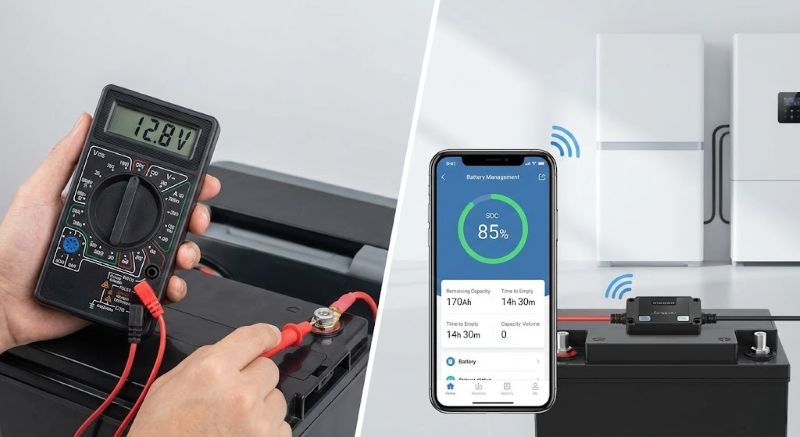
Can you use a standard multimeter to check capacity? The short answer is no. A multimeter measures voltage, which is only a “snapshot” of the battery’s pressure. It cannot tell you the total energy volume.
To get a live reading of your battery capacity, you need a coulomb counter (also known as a battery shunt). These devices sit between the battery and your loads, “counting” every Amp that enters or leaves the system.
High-end solar storage systems now integrate these shunts directly into the Battery Management System (BMS). This allows you to view your remaining energy on a smartphone app in real-time, similar to a fuel gauge in a car.
Factors That Affect Your Measurements
When you measure the battery capacity, several variables can skew your results. Professional technicians always account for these three factors:
1. Temperature (The Thermal Factor)
Batteries rely on chemical reactions. In cold environments (below 0℃), internal resistance increases, which temporarily reduces the available battery capacity. Always conduct tests at room temperature (25℃) for the most accurate baseline.
2. Discharge Rate (Peukert’s Law)
If you drain a battery too fast, you will get a lower capacity reading. This is especially true for lead-acid batteries. Most manufacturers rate their products at a “C/20” rate, meaning a 20-hour discharge.
3. Battery Age and Health
Every charge cycle slightly degrades the internal chemistry. If your 5-year-old battery only shows 70% of its original battery capacity, it has reached its “End of Life” (EOL) for critical applications.
Why Should You Care About Capacity?
Maintaining an accurate log of your system’s health prevents unexpected blackouts. If you notice a steady decline in your battery capacity over six months, you can plan a replacement before the system fails during a storm or peak usage period.
In professional solar installations, such as our recent 14kW project in Armenia, we use precision shunts to ensure the client always knows their “days of autonomy”—how long they can survive without sunlight.
Accuracy Over Estimation
To accurately measure the battery capacity, skip the voltage guestimate and perform a timed discharge test or install a quality battery monitor. Knowing your true energy reserves allows you to optimize your solar usage and extend the lifespan of your hardware.