
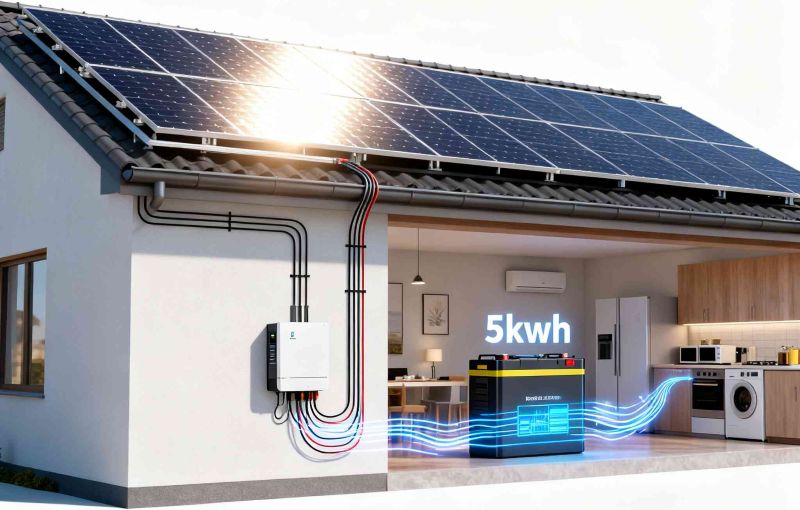
How Long Does a 5kWh Battery Last?
Use this formula for a realistic estimate
Runtime (hours) = battery kWh × allowed DoD × inverter efficiency ÷ average load kW
For a 5kWh battery at 90% DoD and 90% efficiency:
5 × 0.90 × 0.90 = 4.05kWh usable AC energy
If the average load is 0.5kW, 4.05 ÷ 0.5 = 8.1 hours. The key word is average: a refrigerator or pump cycles, while lights and electronics vary throughout the evening.
Use the maximum DoD permitted by the battery manufacturer. The companion guide, How Low Can You Drain a LiFePO4 Battery?, explains why BMS cutoff is not the normal “empty” setting.
5kWh battery runtime by average load
| Average AC load | Ideal runtime at full 5kWh | Planning runtime at 4.05kWh usable |
|---|---|---|
| 100W | 50 hours | 40.5 hours |
| 300W | 16.7 hours | 13.5 hours |
| 500W | 10 hours | 8.1 hours |
| 1,000W | 5 hours | 4.05 hours |
| 1,500W | 3.3 hours | 2.7 hours |
| 2,000W | 2.5 hours | 2.03 hours |
| 3,000W | 1.7 hours | 1.35 hours |
5kWh battery runtime calculator
Change the values to match your data sheet and measured average load.
Planning estimate only. Verify battery usable capacity, inverter efficiency curve, operating temperature, aging allowance and standby power.
Can a 5kWh battery run a whole house?
It can operate a carefully selected set of essential loads, but “whole house” has two separate requirements:
- Energy (kWh) determines how long the loads run.
- Power (kW) and surge capability determine how many loads can run or start at once.
LED lighting, a refrigerator, router, TV, laptop and small electronics may fit a modest essential-load plan. Electric water heating, resistance space heating, ovens, kettles, large air conditioners, well pumps and EV charging can consume the available energy quickly or exceed the inverter’s instantaneous limit.
What reduces real-world runtime?
- Inverter self-consumption: especially important at low loads or over long runtimes.
- Depth-of-discharge reserve: energy intentionally left for battery protection or emergencies.
- Temperature: cold conditions can reduce available capacity and power.
- Battery age and state of health: rated capacity declines over time.
- DC cable and conversion loss: higher current can increase losses.
- Unexpected loads: defrost heaters, pumps and standby devices are easy to miss.
Depth of discharge can affect cycle life, and the relationship is product-specific. See a manufacturer’s model data—such as the Victron lithium battery technical data—and compare test conditions before using cycle-life figures in a design.
How to make a 5kWh battery last longer
- Move only essential circuits onto the backup panel.
- Delay heating, cooling, water heating and cooking loads during an outage.
- Use efficient lighting and appliances; compare products through ENERGY STAR product guidance.
- Schedule pumps and other motor loads so they do not start together.
- Keep battery and inverter in their approved temperature and ventilation range.
- Add solar recharge when the system is designed to operate during outages.
- Stack more compatible battery modules if the required usable kWh is higher.
A complete system must match the battery to a compatible inverter. Compare the 3.6–5kW hybrid inverter and broader home battery backup solutions as starting points.
Frequently asked questions
How many hours will a 5kWh battery last?
Using 90% DoD and 90% inverter efficiency, it provides about 4.05kWh of usable AC energy: approximately 8.1 hours at 500W, 4.1 hours at 1kW or 2 hours at 2kW, before extra allowance for standby losses and battery condition.
Can a 5kWh battery run a whole house?
It can run selected essential loads, but whole-house operation depends on simultaneous power and energy use. Heating, cooling, water heating, cooking and pumps can quickly exceed either battery energy or inverter power.
How long will a 5kWh battery run a refrigerator?
Divide usable battery energy by the refrigerator’s measured average power over a full operating cycle. Do not calculate from compressor running watts alone because the compressor cycles and may include defrost operation.
How do I calculate runtime?
Multiply rated kWh by allowed depth of discharge and inverter efficiency, then divide by average load in kW.
Sources and further reading
Runtime examples are estimates, not guarantees. Final results depend on the battery and inverter data sheets, installation, load profile, temperature and state of health.